 뒤로
뒤로Chp. 1 from worksheet (not filled in by us)
 01:11
01:11
이 집합의 용어 (22)
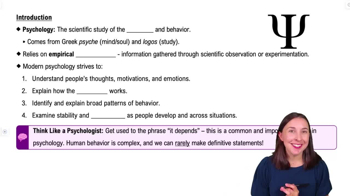
Psychology is the scientific study of the mind and behavior, relying on empirical observation and experimentation.
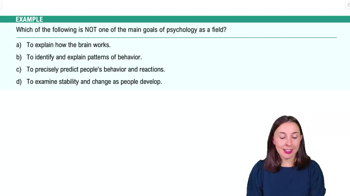
Understand thoughts, motivations, and emotions; explain how the brain works; identify behavior patterns; examine stability and change across development and situations.
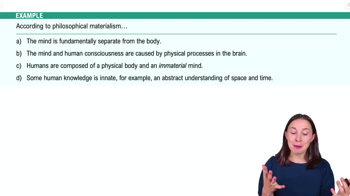
The view that the mind and human consciousness are caused by physical processes in the brain.
Humans are born as tabula rasa or blank slates, with no innate knowledge.
This is Empiricism
Approach that analyzes the basic elements of conscious experience using introspection; founded by Wilhelm Wundt.
Considered the father of modern psychology, opened the first psychology lab in 1879, and studied conscious experience.
Focuses on the adaptive purpose of mental processes and behavior, influenced by Darwin's theory of natural selection.
Known as the father of American psychology and a key figure in functionalism.
A method to gain insight into the unconscious mind, developed by Sigmund Freud, emphasizing unconscious motives and childhood experiences.
Many of Freud's ideas lack empirical support and are difficult to scientifically test.
Emphasizes perception of whole patterns or configurations, summarized as 'the whole is greater than the sum of its parts.'
Founder of Gestalt psychology, studied how the brain organizes sensory information into meaningful wholes.
Focuses on observable behavior and how it is shaped by stimuli and reinforcement; dominant from 1920s to 1950s.
Credited with establishing behaviorism as a formal field in psychology.
Studies how psychological phenomena change over the lifespan, including when, why, and how changes occur.
Examines how individuals' thoughts, feelings, and behaviors are influenced by the social environment.
Focuses on personal growth, potential, and self-improvement; founded by Abraham Maslow and Carl Rogers.
Studies mental processes such as memory, perception, language, and problem solving.
Explores how mental processes and behavior have been shaped by natural selection to solve adaptive problems.
Focuses on how culture influences human behavior and mental processes, advocating for context-specific understanding.
Studies the relationship between the nervous system and behavior or mental processes, including brain mechanisms.
Father of modern neuroscience; first to describe the nervous system as made of cells and detailed neural networks.