뒤로

Chp 3 worksheet AI generated no extras: Biological Psychology
컨트롤 버튼이 '내비게이션' 모드로 변경되었습니다.
1/32
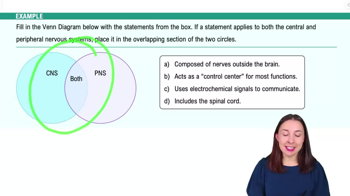
  • What are the two main divisions of the nervous system?

    Central Nervous System (CNS) and Peripheral Nervous System (PNS).
  • What is the primary function of the Central Nervous System (CNS)?

    Acts as the control center for the human body, composed of the brain and spinal cord.
  • What is the role of the Peripheral Nervous System (PNS)?

    Connects the body to the brain; essential for sensation and movement.
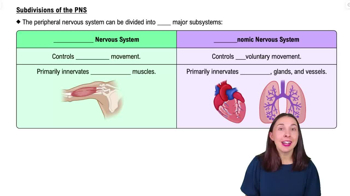
  • What are the two major subsystems of the Peripheral Nervous System?

    Somatic Nervous System (controls voluntary movement) and Autonomic Nervous System (controls involuntary movement).
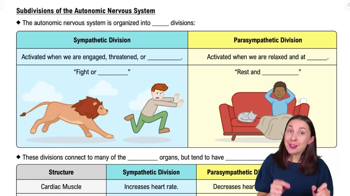
  • What are the two divisions of the Autonomic Nervous System?

    Sympathetic Division (activated during fight or flight) and Parasympathetic Division (activated during rest and digest).
  • How does the sympathetic division affect heart rate and pupils?

    It increases heart rate and dilates pupils.
  • How does the parasympathetic division affect heart rate and pupils?

    It decreases heart rate and constricts pupils.
  • What are the two main types of cells in the nervous system?

    Neurons (communicate via electrochemical signals) and Glial Cells (support, insulate, and nourish neurons).
  • What are the three functional classes of neurons?

    Sensory neurons (receive information), Motor neurons (carry signals to muscles), and Interneurons (connect sensory and motor neurons).
  • What are the basic parts of a neuron?

    Soma (cell body), Dendrites (receive messages), Axon (sends messages), and Axon terminals (release neurotransmitters).
  • What is the function of the myelin sheath?

    A layer of fatty tissue that insulates the axon and helps electrical signals travel faster.
  • What are nodes of Ranvier?

    Gaps in the myelin sheath that facilitate rapid conduction of nerve impulses.
  • What ions are important for neural electrical communication?

    Sodium (Na+) and Potassium (K+) ions.
  • What is an action potential?

    A rapid change in electrical voltage within a neuron that transmits a neural signal.

    -55mv is the threshold trigger for AP

    -70mv is the resting potential

  • Describe the sequence of an action potential.

    1. Depolarization: Na+ floods in, voltage rises. 2. Repolarization: K+ floods out, voltage falls. 3. Refractory period: neuron can't fire. 4. Return to resting potential.

    *get more info: neon gets ions from other neurons, bumps up voltage, opens ion channels, before the 1-4 above

  • What is the synapse?

    The gap between the presynaptic and postsynaptic neurons where chemical communication occurs.

    Pre-synaptic: tip of axon (send signal)

    Post-synaptic: tip of dendrite (receive)

    *think a train and the links between (pre to post)

  • How do neurotransmitters work at the synapse?

    Neurotransmitters are released from vesicles (axon terminal end) in the presynaptic neuron (axon), cross the synapse, and bind to receptors on the postsynaptic neuron (dendrite).

  • What are excitatory and inhibitory neurotransmitters?

    Excitatory neurotransmitters increase the chance of neuron firing; inhibitory neurotransmitters decrease it.
  • Name some important neurotransmitters and their functions.

    Glutamate: major excitatory; GABA: major inhibitory; Serotonin: mood, sleep; Dopamine: reward, movement; Norepinephrine: fight or flight.
  • What is the role of the corpus callosum?

    Connects the two hemispheres of the brain and allows communication between them.
  • What is hemispheric specialization?

    Each hemisphere of the brain is specialized for certain functions.
  • What is contralateral control?

    Each hemisphere controls the opposite side of the body.
  • What are gyri and sulci?

    Gyri are elevated ridges; Sulci are grooves that increase brain surface area.
  • What is the function of Broca's area and Wernicke's area?

    Broca's area controls speech production; Wernicke's area controls language comprehension.
  • What is the homunculus in the sensory and motor cortices?

    A representation showing that larger brain areas correspond to body parts with more sensation or motor control.
  • What is the basal ganglia responsible for?

    Regulating movement, including starting and stopping motions and inhibiting antagonistic movements.
  • What is the limbic system involved in?

    Emotion, memory, motivation, and processing sensory information.
  • What are the functions of the hypothalamus, amygdala, and hippocampus?

    Hypothalamus regulates homeostasis; amygdala processes emotions like fear; hippocampus is key for memory formation.
  • What is the endocrine system?

    A network of glands that release hormones into the bloodstream to regulate body functions.
  • How do hormones differ from neurotransmitters?

    Hormones travel through the bloodstream and have slower but longer-lasting effects; neurotransmitters act quickly across synapses.
  • What is heritability in psychology?

    The proportion of variation in a trait across people that is due to genetic differences.
  • Why are twin studies important in psychology?

    They help separate the effects of genetics and environment on traits.