Skip to main content
Introduction to Psychology
나의 코스
배우기
시험 준비
AI 튜터
학습 가이드
플래시카드
탐험해 보세요
앱을 사용해 보세요
나의 코스
배우기
시험 준비
AI 튜터
학습 가이드
플래시카드
탐험해 보세요
앱을 사용해 보세요
뒤로
Chp.2 worksheet p.1-15
카드를 뒤집기 위해 탭할 수 있습니다.
What is a theory in psychology?
카드를 뒤집기 위해 탭할 수 있습니다.
👆
What is a theory in psychology?
Theory
is an organized system of assumptions and principles that attempts to
explain
a set of phenomena.
진행 상황 추적
컨트롤 버튼이 '내비게이션' 모드로 변경되었습니다.
1/25
추천 영상
VideoThumbView.guidedCourse
03:03
How the Scientific Method Applies to Psychology
1488
views
9
rank
VideoThumbView.guidedCourse
03:04
The Scientifc Method in Psychology Example 3
805
views
6
rank
VideoThumbView.guidedCourse
01:52
The Scientifc Method in Psychology Example 4
811
views
2
rank
이 집합의 용어 (25)
하이드의 정의
What is a theory in psychology?
Theory
is an organized system of assumptions and principles that attempts to
explain
a set of phenomena.
What are the key characteristics of good psychological theories?
Good theories are
testable
,
parsimonious
, and supported by scientific evidence.
What are the main steps of the scientific method in psychology?
Identify a
gap
in knowledge, create a
hypothesis
, design and conduct a study, analyze
data
, draw conclusions, and publish findings.
What is a variable in psychological research?
A
variable
is a construct that can
vary
from person to person or situation to situation.
Difference between independent and dependent variables?
Independent variables
can be manipulated or measured;
dependent variables
are always measured and assumed to be influenced by the IV.
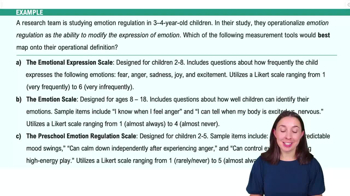
What is an operational definition?
An
operational definition
describes a variable in
observable and measurable
terms, specifying how it is measured.
Why are operational definitions important?
They ensure clarity and consistency in how variables are measured, which can vary across different psychological fields.
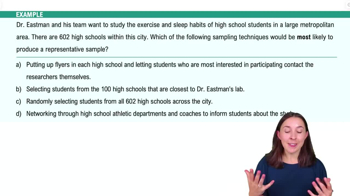
What is the difference between a population and a sample?
Population
is the entire group a researcher wants to understand; a
sample
is the subset selected to participate in the study.
What is random sampling?
A sampling method where every member of the population has an
equal chance
of being selected.
What is a convenience sample?
A
non-random
sample where participants are selected based on availability or willingness to participate.
What is a case study in psychology?
An
in-depth
examination of one person or a small group, often used to study rare or unique phenomena.
Strengths and limitations of case studies?
Strength: Provides detailed information on rare cases. Limitation: Results may be
subjective
and not generalizable.
What is observational research?
A method where researchers systematically
observe and record
behavior with minimal interference.
Difference between naturalistic and laboratory observation?
Naturalistic observation occurs in
natural environments
; laboratory observation occurs in a
controlled setting
.
What are psychometric assessments?
Tools like surveys, interviews, and tests used to
measure psychological constructs
such as attitudes or cognitive skills.
What is reliability in psychological testing?
Reliability
is the consistency of an assessment's scores across time and place.
What is validity in psychological testing?
Validity
refers to the accuracy or appropriateness of conclusions drawn from a test.
What is test-retest reliability?
A measure of consistency where the same test is given to the same group at two different times.
What is construct validity?
The degree to which a test accurately
measures the construct
it intends to measure.
What defines an experiment in psychology?
An experiment is a
controlled test
where one variable is manipulated to discover its effect on another.
Why is random assignment important in experiments?
It increases equivalency between groups, reducing the chance of confounding variables affecting results.
What is the difference between experimental and control groups?
Experimental groups receive the
manipulated independent variable
; control groups do not.
What is a double-blind experiment?
An experiment where both the participant and researcher are
unaware
of the participant's condition to reduce bias.
What are the strengths of experiments?
They provide a high level of control and are the only method that can establish
causation
.
What are limitations of experiments?
Experiments can feel
artificial
and may not generalize well to real-world behavior.
 뒤로뒤로
뒤로뒤로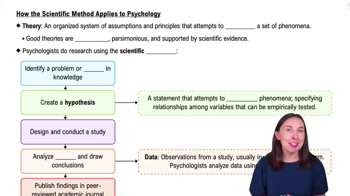
 03:03
03:03