 뒤로
뒤로Introduction to Psychology - Biological Perspective and Nervous System
 01:12
01:12
이 집합의 용어 (42)
Neuroscience is the scientific study of the nervous system, including the brain, spinal cord, and neural circuits.
Biological psychology or behavioral neuroscience studies the relationship between biological processes and behavior.
The nervous system is a network of cells that transmits signals between different parts of the body to coordinate actions and sensory information.
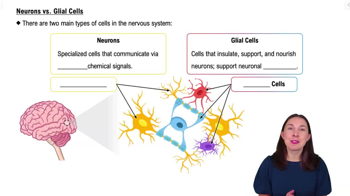
Neurons, which transmit signals, and glial cells, which support and protect neurons.
A neuron is a nerve cell that transmits electrical and chemical signals in the nervous system.
Dendrites, cell body (soma), axon, and axon terminals.
Glial cells provide support, nutrition, and insulation to neurons and help maintain homeostasis.
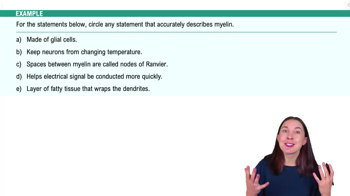
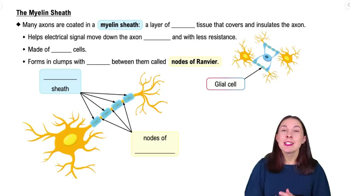
Myelin is a fatty sheath that insulates axons to speed up neural transmission.
Neurotransmission is the process of sending chemical signals across the synapse from one neuron to another.
Synaptic vesicles are small sacs in axon terminals that store neurotransmitters.
Neurotransmitters are chemical messengers that transmit signals across the synaptic gap to receptor sites on the next neuron.
The synapse is the small gap between neurons where neurotransmitters are released.
Receptor sites are locations on the receiving neuron where neurotransmitters bind to influence neural activity.
Excitatory synapses increase the likelihood of the neuron firing; inhibitory synapses decrease it.
Agonists enhance neurotransmitter effects; antagonists block or reduce them.
Acetylcholine is a neurotransmitter involved in muscle movement, learning, and memory.
Hindbrain, midbrain, and forebrain.
The medulla controls vital automatic functions like heartbeat and breathing.
The pons helps regulate sleep, arousal, and facial expressions.
The reticular formation controls arousal and attention.
The cerebellum coordinates voluntary movement and balance.
Thalamus, hypothalamus, hippocampus, amygdala, and cingulate cortex.
The thalamus acts as a relay station for sensory information to the cortex.
The hypothalamus regulates hunger, thirst, temperature, and the endocrine system.
The hippocampus is critical for forming new memories.
The amygdala processes emotions, especially fear and aggression.
Corticalization is the process of the cerebral cortex developing folds to increase surface area.
The corpus callosum is a bundle of nerve fibers connecting the two cerebral hemispheres.
The occipital lobe processes visual information.
The parietal lobe processes sensory information like touch and spatial awareness.
The frontal lobe controls voluntary movement, decision-making, and planning.
Association areas integrate information from different brain regions for complex functions like language and reasoning.
Broca’s aphasia is a language disorder causing difficulty in speech production.
Wernicke’s aphasia causes problems with language comprehension.
Spatial neglect is a condition where a person ignores one side of their visual field, often after right hemisphere damage.
The left hemisphere is involved in language, logic, and analytical thinking.
The right hemisphere processes spatial, creative, and holistic tasks.
The somatic nervous system controls voluntary movements and transmits sensory information to the CNS.
Sensory pathways carry information to the CNS; motor pathways carry commands from the CNS to muscles.
The autonomic nervous system regulates involuntary body functions like heartbeat and digestion.
The sympathetic nervous system prepares the body for 'fight or flight' responses.
The parasympathetic nervous system promotes 'rest and digest' activities to conserve energy.