 뒤로
뒤로Introduction to Psychology - Chapter 1 Key Concepts
 01:11
01:11
이 집합의 용어 (24)
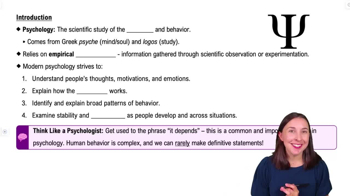
Psychological science is the scientific study of the mind, brain, and behavior.
Psychology studies the mind, brain, and behavior.
Mental processes are internal activities like thinking, remembering, feeling, and decision-making.
Behavior refers to observable actions that a person performs.
No. Psychology covers a broad range of human experiences, not just mental disorders.
Critical thinking means carefully evaluating evidence and reasoning instead of automatically accepting information as true.
Ask: "What is the evidence?" to evaluate claims critically.
A bias is a tendency that can influence thinking or judgment, often unconsciously.
No. People often have difficulty accurately evaluating their own abilities.
The Dunning–Kruger effect is when people with limited knowledge or skill overestimate their ability.
"You don't know what you don't know." This summarizes the effect.
No. People have asked questions about the mind and behavior for thousands of years.
The questions are old, but psychology as a scientific discipline is relatively young.
It means the behavior has a role or purpose.
Fear increases alertness to danger; memory helps us learn from experiences.
No. It means the behavior or process has a particular role or purpose, not necessarily good or bad.
Psychology studies many aspects of life, including memory, emotions, relationships, development, learning, and behavior.
Psychologists study how brain activity, genes, hormones, and the nervous system relate to behavior and mental processes.
Psychology uses data, statistics, computers, and computational methods to study behavior.
Culture develops practices and behaviors that help people adapt and function together.
Studying a phenomenon from different perspectives: biological, individual, social, and cultural.
Brain/hormones → thoughts/emotions → relationships → cultural expectations.
Understanding how people learn and using that research to improve education.
Biology, Data, Culture, Levels, Learning.