Skip to main content
Introduction to Psychology
나의 코스
배우기
시험 준비
AI 튜터
학습 가이드
플래시카드
탐험해 보세요
앱을 사용해 보세요
나의 코스
배우기
시험 준비
AI 튜터
학습 가이드
플래시카드
탐험해 보세요
앱을 사용해 보세요
뒤로
Sensation and Perception - Introduction to Psychology
카드를 뒤집기 위해 탭할 수 있습니다.
What is the difference between sensation and perception?
카드를 뒤집기 위해 탭할 수 있습니다.
👆
What is the difference between sensation and perception?
Sensation
is the raw data gathering from the environment (bottom-up), while
perception
is the brain's interpretation of that raw data (top-down).
진행 상황 추적
컨트롤 버튼이 '내비게이션' 모드로 변경되었습니다.
1/25
추천 영상
VideoThumbView.guidedCourse
01:30
Visual Stimuli Example 1
943
views
22
rank
1
comments
VideoThumbView.guidedCourse
03:43
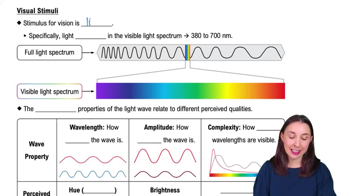
Visual Stimuli
1308
views
25
rank
이 집합의 용어 (25)
하이드의 정의
What is the difference between sensation and perception?
Sensation
is the raw data gathering from the environment (bottom-up), while
perception
is the brain's interpretation of that raw data (top-down).
What is transduction in sensation?
Transduction
is the process of converting sensory stimuli into neural signals that the brain can interpret.
Define absolute threshold.
The
absolute threshold
is the lowest level of a stimulus that can be detected 50% of the time.
What is the Just Noticeable Difference (JND)?
The
JND
is the smallest amount of change in a stimulus that can be detected.
Explain Weber's Law.
Weber's Law states that the stronger the stimulus, the larger the JND needed to detect a change.
What does Signal Detection Theory explain?
It explains how we detect signals amidst noise and accounts for factors like
response bias
in sensory detection.
What is selective attention?
Selective attention is the brain's ability to focus on important sensory information while filtering out less relevant stimuli.
What is inattentional blindness?
Inattentional blindness is the failure to notice visible stimuli when attention is focused elsewhere.
What is change blindness?
Change blindness is the failure to detect changes in the environment, especially when attention is diverted.
What are the three visible structures of the eye?
The
sclera
(white part),
iris
(colored part controlling pupil size), and
pupil
(light entry point).
What are rods and cones in the retina?
Rods
detect basic shapes and forms;
cones
detect color and detail.
Summarize the Trichromatic Theory of color vision.
We perceive color through three types of cones sensitive to red, blue, and green light.
What does the Opponent Process Theory explain?
It explains color perception through three pairs of opponent cells: red-green, blue-yellow, and black-white, accounting for afterimages.
What are the main characteristics of sound waves?
Pitch
(frequency),
loudness
(amplitude), and
timbre
(quality or complexity).
Describe the basic parts of the ear involved in hearing.
The
outer ear
funnels sound, the
middle ear
transmits vibrations, and the
inner ear
(cochlea) converts vibrations into neural signals.
What is the Place Theory of pitch perception?
Pitch is determined by the location of hair cell activation on the basilar membrane; explains high-pitched sounds.
What is the Frequency Theory of pitch perception?
Pitch is determined by the rate of neural firing; explains low-pitched sounds.
How do smell and taste receptors work?
Olfactory neurons have receptors recognizing odorants by shape; taste buds detect five basic flavors: sweet, salty, sour, bitter, and umami.
What is sensory adaptation?
Sensory adaptation is the decrease in sensitivity to a stimulus after prolonged exposure.
What is bottom-up processing?
Perception driven by sensory input features without influence from prior knowledge.
What is top-down processing?
Perception influenced by beliefs, expectations, and prior knowledge.
What are monocular and binocular cues in visual perception?
Monocular cues use one eye (e.g., relative size), binocular cues use both eyes (e.g., binocular disparity) for depth perception.
What is subliminal perception?
Processing stimuli presented below conscious awareness that may influence behavior temporarily.
What is the cocktail party effect?
The ability to focus on a single conversation in a noisy environment while filtering out other stimuli.
What is the function of the fovea?
The fovea is the point of central focus in the retina with the highest concentration of cones for detailed vision.
 뒤로뒤로
뒤로뒤로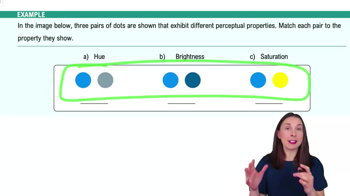
 01:30
01:30