Skip to main content
Introduction to Sociology
나의 코스
배우기
AI 튜터
학습 가이드
플래시카드
탐험해 보세요
앱을 사용해 보세요
나의 코스
배우기
AI 튜터
학습 가이드
플래시카드
탐험해 보세요
앱을 사용해 보세요
뒤로
Economic Systems definitions
카드를 뒤집기 위해 탭할 수 있습니다.
Capitalism
카드를 뒤집기 위해 탭할 수 있습니다.
👆
Capitalism
An economic system where natural resources and production means are primarily under private ownership, driven by profit and market forces.
진행 상황 추적
컨트롤 버튼이 '내비게이션' 모드로 변경되었습니다.
1/20
관련 플래시카드
추천 영상
Economic Systems quiz
Economic Systems
15 용어
VideoThumbView.guidedCourse
01:56
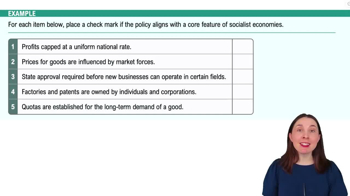
Economic Systems Example 3
37
views
VideoThumbView.guidedCourse
01:11
Economic Systems Example 2
31
views
VideoThumbView.guidedCourse
03:38
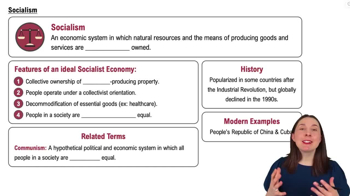
Socialism
41
views
이 집합의 용어 (20)
하이드의 정의
Capitalism
An economic system where natural resources and production means are primarily under private ownership, driven by profit and market forces.
Private Ownership
Control of wealth-producing property, factories, or patents by individuals or corporations rather than the state.
Profit Motive
A behavioral driver where individuals and businesses seek personal gain through work, investment, or enterprise.
Market Forces
Mechanisms of supply and demand regulated by competition and consumer choice, not direct government control.
Competition
Rivalry among firms to offer better value and quality, influencing prices and innovation.
Consumer Choice
Ability of buyers to select goods and services based on value and quality, shaping market outcomes.
Welfare Capitalism
A system blending market-based economy with extensive social welfare programs and higher government regulation.
Social Welfare Programs
Government initiatives like universal health care or child care, funded by higher taxation to support citizens.
Socialism
An economic system where natural resources and production means are collectively owned, often by the government.
Collective Ownership
Control of wealth-producing property and resources by society as a whole, typically managed by the state.
Collectivist Orientation
A societal expectation to work for the common good rather than personal profit.
Decommodification
Process where essential goods like housing or health care are made universally accessible, not treated as market commodities.
Economic Equality
A condition where income gaps between different occupations are minimized within a society.
Industrial Revolution
A historical period that popularized both capitalism and socialism, influencing economic inequality and system shifts.
Communism
A hypothetical system proposing complete social and economic equality, resulting in a classless society.
Classless Society
A social structure where all individuals possess equal power and status, eliminating hierarchical divisions.
Means of Production
Resources and facilities used to produce goods and services, such as factories, land, and technology.
Regulation
Government involvement in overseeing and controlling economic activities, often to ensure fairness or social welfare.
Taxation
Collection of financial resources by the government, often higher in systems with extensive social programs.
Income Gap
The disparity in earnings between different social or occupational groups within an economy.
 뒤로뒤로
뒤로뒤로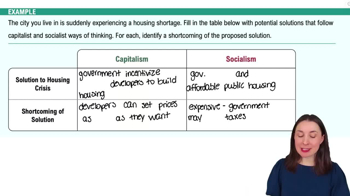
 01:56
01:56