Skip to main content
Introduction to Sociology
나의 코스
배우기
AI 튜터
학습 가이드
플래시카드
탐험해 보세요
앱을 사용해 보세요
나의 코스
배우기
AI 튜터
학습 가이드
플래시카드
탐험해 보세요
앱을 사용해 보세요
뒤로
Issues in U.S. Education definitions
카드를 뒤집기 위해 탭할 수 있습니다.
Bureaucracy
카드를 뒤집기 위해 탭할 수 있습니다.
👆
Bureaucracy
A system of organization with rigid rules and procedures, often leading to uniformity and limited flexibility in large institutions.
진행 상황 추적
컨트롤 버튼이 '내비게이션' 모드로 변경되었습니다.
1/29
관련 플래시카드
추천 영상
Issues in U.S. Education quiz
Issues in U.S. Education
15 용어
VideoThumbView.guidedCourse
04:00
Academic Standards and Initiatives
21
views
VideoThumbView.guidedCourse
01:14
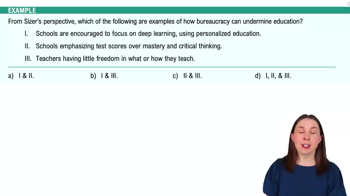
Issues in U.S. Education Example 1
36
views
VideoThumbView.guidedCourse
04:20
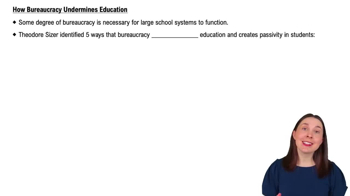
How Bureaucracy Undermines Education
28
views
이 집합의 용어 (29)
하이드의 정의
Bureaucracy
A system of organization with rigid rules and procedures, often leading to uniformity and limited flexibility in large institutions.
Uniformity
A consistent structure and curriculum across schools, which can ignore cultural and individual differences among students.
Flexibility
The ability of schools to adapt to students' needs, allowing for personalized learning and less rigid expectations.
Standardized Testing
Assessments used to measure student achievement, often influencing curriculum and school funding decisions.
Teaching to the Test
A focus on preparing students for exams rather than fostering deep understanding or critical thinking skills.
Critical Thinking
The capacity to analyze, evaluate, and synthesize information beyond rote memorization or basic comprehension.
Transferable Skills
Abilities such as problem-solving and communication that can be applied in various contexts beyond school.
School Readiness
The level of knowledge and skills children possess when entering formal education, often influenced by socioeconomic status.
Head Start Program
A federal initiative providing early childhood education to low-income children to reduce socioeconomic gaps.
No Child Left Behind Act
A policy mandating standardized testing and linking school funding to test performance, criticized for narrowing curricula.
Every Student Succeeds Act
A law granting states more control over education funding and standards while maintaining testing requirements.
Local Property Taxes
A primary source of public school funding, leading to disparities between affluent and low-income districts.
Affluent Districts
School areas with higher funding, offering more resources, advanced courses, and extracurricular opportunities.
Low-Income Districts
School areas with limited funding, often facing overcrowding, fewer programs, and outdated facilities.
Overcrowding
A situation where too many students are in a classroom, reducing opportunities for individualized instruction.
Advanced Courses
Educational offerings such as AP classes or dual enrollment, typically available in well-funded schools.
Extracurriculars
Non-academic activities like arts and sports, often cut in underfunded schools, affecting student development.
Functional Illiteracy
A condition where individuals can read words but struggle with comprehension and applying reading skills in daily life.
Socioeconomic Status (SES)
A measure of a family's economic and social position, influencing educational opportunities and outcomes.
Racial Education Gap
Disparities in educational achievement and access among different racial groups, often linked to funding inequalities.
Conflict Theory
A sociological perspective highlighting how education systems perpetuate social and economic inequalities.
Teacher Specialization
A structure where educators focus on specific subjects, limiting opportunities for personalized student interaction.
Grade Progression
A system where student advancement is based on age and grade, often lacking personalization for individual needs.
Accountability
The expectation for schools, teachers, and students to meet certain standards, often enforced through testing.
Student-Led Learning
An approach where learners have more choice and agency in their educational activities and assessments.
Teacher Autonomy
The freedom for educators to design curriculum and teaching methods, often restricted by bureaucratic policies.
Staff Turnover
The rate at which teachers and school employees leave and are replaced, often higher in underfunded schools.
College Access
The opportunity for students to pursue higher education, influenced by high school resources and extracurricular involvement.
School Bureaucracy
The administrative structure governing schools, often criticized for limiting innovation and responsiveness.
 뒤로뒤로
뒤로뒤로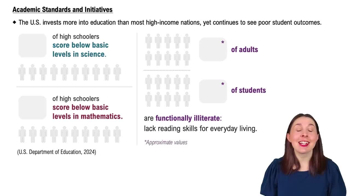
 04:00
04:00