Skip to main content
Introductory Statistics
나의 코스
배우기
시험 준비
AI 튜터
학습 가이드
교과서적 해결책
플래시카드
탐험해 보세요
앱을 사용해 보세요
나의 코스
배우기
시험 준비
AI 튜터
학습 가이드
교과서적 해결책
플래시카드
탐험해 보세요
앱을 사용해 보세요
뒤로
Basic Concepts of Probability quiz #1
3 학생들은 이 점이 도움이 되었다고 느꼈습니다
카드를 뒤집기 위해 탭할 수 있습니다.
What is an example of random selection in probability?
카드를 뒤집기 위해 탭할 수 있습니다.
👆
What is an example of random selection in probability?
Random selection occurs when each member of a group has an equal chance of being chosen, such as drawing names from a hat.
진행 상황 추적
컨트롤 버튼이 '내비게이션' 모드로 변경되었습니다.
1/40
관련 플래시카드
관련 실천
추천 영상
Basic Concepts of Probability quiz #2
Basic Concepts of Probability
40 용어
Basic Concepts of Probability quiz #3
Basic Concepts of Probability
40 용어
Basic Concepts of Probability quiz #4
Basic Concepts of Probability
39 용어
Basic Concepts of Probability
4. Probability
7 문제점
주제
Ernest
Complements
4. Probability
4 문제점
주제
Ernest
4. Probability - Part 1 of 3
3 주제
9 문제점
장
Ernest
4. Probability - Part 2 of 3
4 주제
12 문제점
장
Ernest
4. Probability - Part 3 of 3
2 주제
6 문제점
장
Ally
VideoThumbView.guidedCourse
5:37
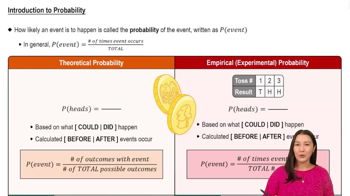
Introduction to Probability
10153
views
374
rank
1
comments
이 집합의 용어 (40)
하이드의 정의
What is an example of random selection in probability?
Random selection occurs when each member of a group has an equal chance of being chosen, such as drawing names from a hat.
How is the independent variable identified in a probability experiment?
The independent variable is the variable that is manipulated or categorized to observe its effect on the outcome.
What is a qualitative measurement in statistics?
A qualitative measurement describes non-numeric characteristics, such as color or type.
What is the theoretical probability of a coin landing on tails in a single toss?
The theoretical probability is 1/2, or 0.5.
How do you calculate the probability of choosing a specific letter from a word?
Divide the number of times the letter appears by the total number of letters in the word.
What are the requirements for a valid probability distribution?
All probabilities must be between 0 and 1, and the sum of all probabilities must equal 1.
What does it mean if a statistic is resistant?
A resistant statistic is not significantly affected by extreme values or outliers.
What is the difference between a parameter and a statistic?
A parameter describes a characteristic of a population, while a statistic describes a characteristic of a sample.
What are the two requirements for a discrete probability distribution?
Each probability must be between 0 and 1, and the sum of all probabilities must be 1.
What is the probability of an event that is certain?
The probability of a certain event is 1.
Does sampling error increase or decrease when sample size increases?
Sampling error generally decreases as sample size increases.
If ten out of every 32 people surveyed play a game, what percent of people surveyed play the game?
The percent is (10/32) × 100 = 31.25%.
What does it mean when sampling is done without replacement?
It means that once an item is selected, it is not returned to the population for possible reselection.
What is the sum of the probabilities for all possible outcomes in a probability distribution?
The sum is always 1.
Why is a sample used more often than a population in statistics?
Samples are used because it is often impractical or impossible to collect data from an entire population.
Are data at the nominal level of measurement quantitative or qualitative?
Nominal data are qualitative.
Why is a sample used more often than a population in statistical studies?
Because sampling is more practical, less costly, and less time-consuming than studying the entire population.
How would you describe a probability distribution?
A probability distribution lists all possible outcomes and their associated probabilities.
What does it mean for two variables to be positively or negatively associated?
Positively associated variables increase together; negatively associated variables move in opposite directions.
What are the requirements for a valid probability distribution?
Probabilities must be between 0 and 1, and their sum must be 1.
How is a sample related to a population?
A sample is a subset of a population, used to make inferences about the population.
How do you estimate the probability that a random variable falls within a given interval?
Sum the probabilities of all outcomes within the interval, or calculate the area under the probability curve for continuous variables.
What is the probability of an impossible event?
The probability is 0.
What is the probability of rolling a prime number on a standard 6-sided die?
There are three prime numbers (2, 3, 5), so the probability is 3/6 = 0.5 or 50%.
Which type of data distribution is likely to have a mean and median that are not close in value?
A skewed distribution.
What does it mean for events to be mutually exclusive?
Mutually exclusive events cannot occur at the same time.
What is the reasoning process that moves from particular facts to a general conclusion?
Inductive reasoning.
How do you determine if two events are independent?
Events are independent if the occurrence of one does not affect the probability of the other.
Why do pollsters rely on random sampling?
Random sampling reduces bias and ensures that the sample represents the population.
How do you calculate the probability of selecting an item with multiple characteristics?
Add the probabilities of each characteristic, subtracting any overlap if necessary.
What is an example of a continuous random variable?
Height or time are examples of continuous random variables.
What type of data can be reasonably modeled by a normal distribution?
Continuous data that are symmetrically distributed around the mean.
What are the requirements for an independent random sample?
Each member of the population has an equal chance of selection, and selections are made independently.
What is a possible probability distribution?
A distribution where all probabilities are between 0 and 1 and sum to 1.
Which distribution is commonly used to calculate the probability of producing a defect?
The binomial distribution.
What is a cumulative probability?
A cumulative probability is the probability that a random variable is less than or equal to a certain value.
What is an example of inferential statistics?
Using a sample to estimate the mean of a population.
Which is not a principle of probability?
Probabilities can be negative.
What is the most widely used continuous probability distribution?
The normal distribution.
What is the difference between random selection and nonrandom selection?
Random selection gives each member an equal chance; nonrandom selection does not.
 뒤로뒤로
뒤로뒤로

 5:37
5:37