Skip to main content
Introductory Statistics
나의 코스
배우기
시험 준비
AI 튜터
학습 가이드
교과서적 해결책
플래시카드
탐험해 보세요
앱을 사용해 보세요
나의 코스
배우기
시험 준비
AI 튜터
학습 가이드
교과서적 해결책
플래시카드
탐험해 보세요
앱을 사용해 보세요
뒤로
Independence Tests definitions
카드를 뒤집기 위해 탭할 수 있습니다.
Independence
카드를 뒤집기 위해 탭할 수 있습니다.
👆
Independence
A property where two variables do not influence each other; their outcomes are unrelated in the context of categorical data.
진행 상황 추적
컨트롤 버튼이 '내비게이션' 모드로 변경되었습니다.
1/13
관련 플래시카드
관련 실천
추천 영상
Independence Tests quiz #1
Independence Tests
10 용어
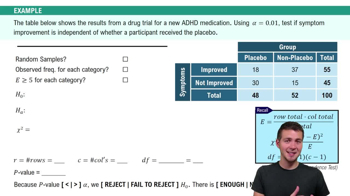
Chi Square Test for Independence
13. Chi-Square Tests & Goodness of Fit
3 문제점
주제
Chi Square Test for Homogeneity
13. Chi-Square Tests & Goodness of Fit
3 문제점
주제
13. Chi-Square Tests & Goodness of Fit
4 주제
5 문제점
장
VideoThumbView.guidedCourse
06:28
Independence Test
482
views
7
rank
VideoThumbView.guidedCourse
08:07
Independence Test Example 1
333
views
2
rank
이 집합의 용어 (13)
하이드의 정의
Independence
A property where two variables do not influence each other; their outcomes are unrelated in the context of categorical data.
Categorical Variable
A variable that takes on values representing distinct groups or categories, such as grade levels or height ranges.
Null Hypothesis
The default assumption stating that two variables are unrelated; used as a starting point in statistical testing.
Alternative Hypothesis
A statement suggesting that two variables are related; considered when evidence contradicts the default assumption.
Chi-square Test Statistic
A value calculated from observed and expected frequencies to measure the discrepancy between them in a contingency table.
Observed Frequency
The actual count of occurrences recorded in each category or cell of a data table.
Expected Frequency
A calculated value predicting the count in each category, assuming independence, based on row and column totals.
Contingency Table
A matrix displaying the frequency distribution of two categorical variables, organized by rows and columns.
Degrees of Freedom
A parameter determined by the formula (rows-1)(columns-1), indicating the number of values free to vary in the test.
P-value
A probability quantifying how likely observed results are under the null hypothesis; used to guide decision-making.
Significance Level
A threshold, often denoted as alpha, for deciding whether to reject the null hypothesis based on the p-value.
Random Sample
A selection method ensuring each member of a population has an equal chance of inclusion, supporting valid inference.
Goodness of Fit Test
A statistical procedure comparing observed frequencies to a claimed distribution for a single categorical variable.
 뒤로뒤로
뒤로뒤로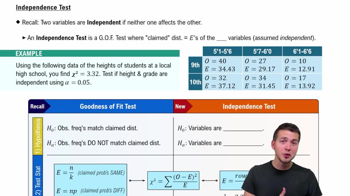
 06:28
06:28