Skip to main content
Introductory Statistics
나의 코스
배우기
시험 준비
AI 튜터
학습 가이드
교과서적 해결책
플래시카드
탐험해 보세요
앱을 사용해 보세요
나의 코스
배우기
시험 준비
AI 튜터
학습 가이드
교과서적 해결책
플래시카드
탐험해 보세요
앱을 사용해 보세요
뒤로
Fundamental Counting Principle definitions
카드를 뒤집기 위해 탭할 수 있습니다.
Fundamental Counting Principle
카드를 뒤집기 위해 탭할 수 있습니다.
👆
Fundamental Counting Principle
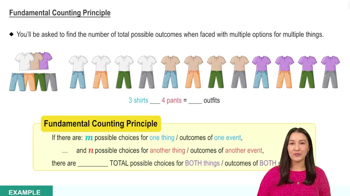
A method for quickly finding total outcomes by multiplying the number of options for each event or item.
진행 상황 추적
컨트롤 버튼이 '내비게이션' 모드로 변경되었습니다.
1/15
관련 플래시카드
관련 실천
추천 영상
Fundamental Counting Principle quiz
Fundamental Counting Principle
15 용어
Fundamental Counting Principle
4. Probability
6 문제점
주제
Ernest
Counting
4. Probability
6 문제점
주제
Ernest
4. Probability - Part 1 of 3
3 주제
9 문제점
장
Ernest
4. Probability - Part 2 of 3
4 주제
12 문제점
장
Ernest
4. Probability - Part 3 of 3
2 주제
6 문제점
장
Ally
VideoThumbView.guidedCourse
04:04
Fundamental Counting Principle
3326
views
58
rank
이 집합의 용어 (15)
하이드의 정의
Fundamental Counting Principle
A method for quickly finding total outcomes by multiplying the number of options for each event or item.
Outcome
A possible result from an event, such as flipping a coin or rolling a die.
Event
An occurrence or action, like choosing a shirt or rolling a die, with distinct possible results.
Choice
A selection among available options, such as picking an appetizer or a shirt.
Option
An available alternative in a set, like a specific shirt, pair of pants, or meal item.
Combination
A grouping formed by selecting one item from each category, calculated using multiplication.
Probability
A measure of how likely an outcome is, often determined by counting possible results.
Combinatorics
A branch of mathematics focused on counting, arranging, and grouping objects.
Menu
A list of available food items, such as appetizers and entrees, used to illustrate counting choices.
Appetizer
A food item offered as a starter, representing one category of choices in counting problems.
Entree
A main course option, used as a category for calculating meal combinations.
Coin
An object with two possible outcomes, heads or tails, used in probability examples.
Die
A six-sided object with numbered faces, each representing a possible outcome.
Multiplication
A mathematical operation used to combine the number of options for each event to find total outcomes.
Category
A group of similar items, such as shirts or pants, from which selections are made.
 뒤로뒤로
뒤로뒤로

 04:04
04:04