Skip to main content
Introductory Statistics
나의 코스
배우기
시험 준비
AI 튜터
학습 가이드
교과서적 해결책
플래시카드
탐험해 보세요
앱을 사용해 보세요
나의 코스
배우기
시험 준비
AI 튜터
학습 가이드
교과서적 해결책
플래시카드
탐험해 보세요
앱을 사용해 보세요
뒤로
Intro to Stats definitions
11 학생들은 이 점이 도움이 되었다고 느꼈습니다
카드를 뒤집기 위해 탭할 수 있습니다.
Statistics
카드를 뒤집기 위해 탭할 수 있습니다.
👆
Statistics
Branch of science focused on collecting and analyzing data to inform decisions about groups or entities.
진행 상황 추적
컨트롤 버튼이 '내비게이션' 모드로 변경되었습니다.
1/13
관련 플래시카드
관련 실천
추천 영상
Intro to Stats quiz #1
Intro to Stats
28 용어
Intro to Stats
1. Intro to Stats and Collecting Data
5 문제점
주제
Brendan
Levels of Measurement
1. Intro to Stats and Collecting Data
5 문제점
주제
David-Paige
1. Intro to Stats and Collecting Data
4 주제
12 문제점
장
Brendan
VideoThumbView.guidedCourse
04:24
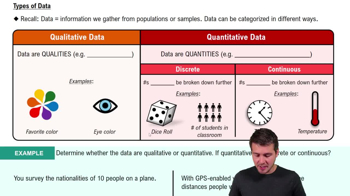
Types of Data
18503
views
1160
rank
6
comments
VideoThumbView.guidedCourse
05:53
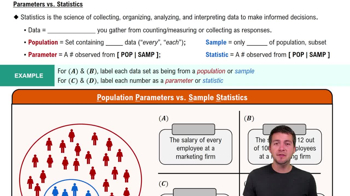
Parameters vs. Statistics
28919
views
1707
rank
6
comments
VideoThumbView.guidedCourse
2:13
Introduction to Statistics Channel
37727
views
1425
rank
8
comments
이 집합의 용어 (13)
하이드의 정의
Statistics
Branch of science focused on collecting and analyzing data to inform decisions about groups or entities.
Data
Information collected as measurements, counts, or responses, forming the basis for analysis and interpretation.
Population
Entire group of interest containing all relevant data, measurements, or responses for a specific study.
Sample
Subset of a population selected to represent and provide insights about the larger group.
Parameter
Numerical value summarizing a characteristic of a population, such as an average or proportion.
Statistic
Numerical value summarizing a characteristic of a sample, used to estimate population parameters.
Qualitative Data
Information categorized by names, labels, or attributes, lacking inherent numerical value for calculations.
Quantitative Data
Information expressed as numbers or measurements, suitable for mathematical operations and analysis.
Discrete Variable
Numerical data with countable values that cannot be subdivided, such as dice rolls or student counts.
Continuous Variable
Numerical data that can be divided into finer units, allowing for decimals and fractions, like time or distance.
Business Analytics
Application of statistical methods to interpret data and guide decision-making in commercial contexts.
Inferential Statistics
Techniques used to draw conclusions about populations based on sample data, often involving estimation or prediction.
Attribute
Characteristic or quality used to categorize qualitative data, such as eye color or nationality.
 뒤로뒤로
뒤로뒤로
 04:24
04:24