Skip to main content
Introductory Statistics
나의 코스
배우기
시험 준비
AI 튜터
학습 가이드
교과서적 해결책
플래시카드
탐험해 보세요
앱을 사용해 보세요
나의 코스
배우기
시험 준비
AI 튜터
학습 가이드
교과서적 해결책
플래시카드
탐험해 보세요
앱을 사용해 보세요
뒤로
Multiplication Rule: Independent Events definitions
카드를 뒤집기 위해 탭할 수 있습니다.
Independent Events
카드를 뒤집기 위해 탭할 수 있습니다.
👆
Independent Events
Two occurrences where the result of one has no influence on the result of the other.
진행 상황 추적
컨트롤 버튼이 '내비게이션' 모드로 변경되었습니다.
1/15
관련 플래시카드
관련 실천
추천 영상
Multiplication Rule: Independent Events quiz #1
Multiplication Rule: Independent Events
10 용어
Multiplication Rule: Independent Events
4. Probability
5 문제점
주제
Ernest
Introduction to Contingency Tables
4. Probability
5 문제점
주제
Ernest
4. Probability - Part 1 of 3
3 주제
9 문제점
장
Ernest
4. Probability - Part 2 of 3
4 주제
12 문제점
장
Ernest
4. Probability - Part 3 of 3
2 주제
6 문제점
장
Ally
VideoThumbView.guidedCourse
05:54
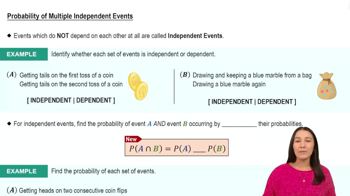
Probability of Multiple Independent Events
5357
views
114
rank
이 집합의 용어 (15)
하이드의 정의
Independent Events
Two occurrences where the result of one has no influence on the result of the other.
Dependent Events
Two occurrences where the result of one alters the likelihood of the other.
Probability
A numerical measure expressing the chance of a specific outcome among all possible outcomes.
And Probability
The likelihood of multiple occurrences happening together, calculated by multiplying their individual chances.
Multiplication Rule
A method for finding the joint chance of independent occurrences by multiplying their separate probabilities.
Set Notation
A symbolic representation, often using an upside-down U, to denote the intersection of occurrences.
Joint Probability
A measure of the chance that two or more occurrences happen simultaneously.
Outcome
A possible result from a random process, such as a coin flip or die roll.
Sample Space
The complete collection of all possible results from a random process.
Consecutive Trials
Multiple random processes performed one after another, such as repeated coin flips.
Event
A specific result or group of results from a random process.
Intersection
The set of results where multiple occurrences happen together, often denoted by an upside-down U.
Decimal Probability
A chance expressed as a number between 0 and 1, representing the proportion of favorable results.
Numerator
The top part of a fraction representing favorable results in probability calculations.
Denominator
The bottom part of a fraction representing the total number of possible results in probability calculations.
 뒤로뒤로
뒤로뒤로

 05:54
05:54