Skip to main content
Introductory Statistics
나의 코스
배우기
시험 준비
AI 튜터
학습 가이드
교과서적 해결책
플래시카드
탐험해 보세요
앱을 사용해 보세요
나의 코스
배우기
시험 준비
AI 튜터
학습 가이드
교과서적 해결책
플래시카드
탐험해 보세요
앱을 사용해 보세요
뒤로
Sampling Methods definitions
2 학생들은 이 점이 도움이 되었다고 느꼈습니다
카드를 뒤집기 위해 탭할 수 있습니다.
Population
카드를 뒤집기 위해 탭할 수 있습니다.
👆
Population
Entire group of individuals or items under study, from which samples are drawn for statistical analysis.
진행 상황 추적
컨트롤 버튼이 '내비게이션' 모드로 변경되었습니다.
1/15
관련 플래시카드
관련 실천
추천 영상
Sampling Methods quiz #1
Sampling Methods
1 용어
Sampling Methods
1. Intro to Stats and Collecting Data
5 문제점
주제
Ally
Intro to Collecting Data
1. Intro to Stats and Collecting Data
5 문제점
주제
Brendan
1. Intro to Stats and Collecting Data
4 주제
12 문제점
장
Brendan
VideoThumbView.guidedCourse
03:07
Sampling Methods Example 2
4036
views
318
rank
VideoThumbView.guidedCourse
01:30
Simple Random Sampling Example 1
5096
views
185
rank
1
comments
VideoThumbView.guidedCourse
05:27
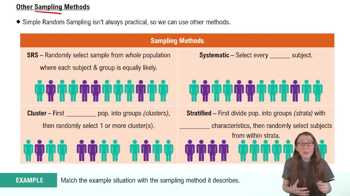
Sampling Methods
5859
views
174
rank
3
comments
이 집합의 용어 (15)
하이드의 정의
Population
Entire group of individuals or items under study, from which samples are drawn for statistical analysis.
Sample
Subset of a population selected for analysis, used to make inferences about the whole group.
Sampling Frame
List or database containing all elements of a population, serving as the basis for selecting samples.
Random Sampling
Technique where each member of the population has an equal chance of being chosen, minimizing bias.
Stratified Sampling
Method dividing the population into subgroups and selecting samples from each, ensuring representation.
Cluster Sampling
Approach where groups or clusters are randomly chosen, and all or some members within are studied.
Systematic Sampling
Procedure involving selection of every nth item from a list, starting from a random point.
Convenience Sampling
Non-random method relying on easily accessible subjects, often leading to less representative samples.
Quota Sampling
Technique where researchers ensure certain characteristics are proportionally represented in the sample.
Sampling Bias
Distortion in results caused by non-random selection or exclusion of certain population segments.
Nonresponse
Situation where selected individuals do not participate, potentially affecting the accuracy of results.
Sampling Error
Difference between sample results and true population values, arising from chance selection.
Simple Random Sample
Subset chosen so every possible group of a given size has an equal probability of selection.
Voluntary Response
Sampling method where participants self-select, often leading to overrepresentation of strong opinions.
Representative Sample
Subset reflecting the characteristics of the population, allowing for valid generalizations.
 뒤로뒤로
뒤로뒤로
 03:07
03:07