Skip to main content
Statistics
나의 코스
배우기
시험 준비
AI 튜터
학습 가이드
교과서적 해결책
플래시카드
탐험해 보세요
앱을 사용해 보세요
나의 코스
배우기
시험 준비
AI 튜터
학습 가이드
교과서적 해결책
플래시카드
탐험해 보세요
앱을 사용해 보세요
뒤로
Elementary Statistics - Probability Concepts
카드를 뒤집기 위해 탭할 수 있습니다.
What is an event in probability?
카드를 뒤집기 위해 탭할 수 있습니다.
👆
What is an event in probability?
An
event
is any collection of results or outcomes of a procedure.
진행 상황 추적
컨트롤 버튼이 '내비게이션' 모드로 변경되었습니다.
1/20
추천 영상
5:37
Introduction to Probability
9303
views
335
rank
1
comments
이 집합의 용어 (20)
하이드의 정의
What is an event in probability?
An
event
is any collection of results or outcomes of a procedure.
Define a simple event.
A
simple event
is an outcome or event that cannot be further broken down into simpler components.
What is the sample space of a procedure?
The
sample space
consists of all possible simple events or outcomes that cannot be broken down any further.
What does P(A) represent in probability notation?
P(A) denotes the
probability of event A occurring
.
What are the possible values of probabilities?
Probabilities range from
0 to 1
, where 0 means the event never occurs and 1 means the event always occurs.
Describe the relative frequency approximation of probability.
It approximates P(A) by conducting a procedure many times and calculating the ratio of times event A occurs to the total number of trials.
What is the classical approach to probability?
If a procedure has n equally likely simple events and event A can occur in s ways, then P(A) = \(\frac{s}{n}\).
What caution should be taken when using the classical approach?
Always confirm that the outcomes are
equally likely
before using the classical approach.
What are subjective probabilities?
Probabilities estimated using knowledge of relevant circumstances rather than exact calculations or data.
What is a simulation in probability?
A process that behaves like the actual procedure to produce similar results, used when other probability approaches are not feasible.
How should probabilities be rounded or expressed?
Express probabilities as exact fractions or decimals rounded to three significant digits for clarity.
State the Law of Large Numbers.
As a procedure is repeated many times, the relative frequency probability tends to approach the actual probability.
What is the complement of an event A?
The complement, denoted \(A^c\), consists of all outcomes where event A does not occur.
Explain the Rare Event Rule for Inferential Statistics.
If an observed event has a very small probability under an assumption, the assumption is likely incorrect.
When is a number of successes considered significantly high?
If the probability of x or more successes is ≤ 0.05, x is significantly high.
When is a number of successes considered significantly low?
If the probability of x or fewer successes is ≤ 0.05, x is significantly low.
Define actual odds against an event A.
The ratio of the number of ways event A does not occur to the number of ways it does, expressed as a:b.
How are actual odds in favor of event A related to odds against?
Actual odds in favor are the inverse ratio of odds against; if odds against are a:b, odds in favor are b:a.
What are payoff odds against an event?
The ratio of net profit to the amount bet, expressed as (net profit):(amount bet).
Why do casinos offer payoff odds different from actual odds?
Casinos offer payoff odds less favorable than actual odds to ensure a profit margin.
 뒤로뒤로
뒤로뒤로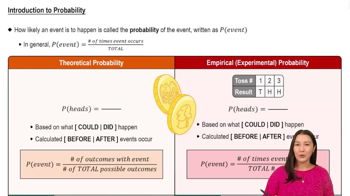
 5:37
5:37