
Ch. 1 - Introduction to Statistics
Larson - Elementary Statistics: Picturing the World 8th Edition
Larson8th EditionElementary Statistics: Picturing the WorldISBN: 9780137493470당신이 사용하는 게 아니라요?교과서 변경
1장, 문제 1.1.48

A study showed an association between intentional weight loss and a decreased risk of high blood pressure. Is it appropriate to infer from this study that weight loss causes a decreased risk of high blood pressure? Explain. (Source: European Association for the Study of Obesity)

검증된 단계별 안내
1
Step 1: Understand the concept of causation versus association. Association means that two variables are related, but it does not imply that one causes the other. Causation, on the other hand, indicates that one variable directly affects the other.
Step 2: Evaluate the study design. Determine whether the study was observational or experimental. Observational studies can show associations but cannot establish causation due to potential confounding variables. Experimental studies, such as randomized controlled trials, are better suited for establishing causation.
Step 3: Consider confounding variables. Confounding occurs when a third variable influences both the independent variable (weight loss) and the dependent variable (risk of high blood pressure), potentially creating a false association.
Step 4: Assess whether the study controlled for confounding variables. If the study did not account for factors such as diet, exercise, or genetics, the observed association might not be due to weight loss alone.
Step 5: Conclude that without evidence from a well-designed experimental study, it is not appropriate to infer causation. The study shows an association, but causation requires stronger evidence, such as randomized controlled trials that eliminate confounding factors.

비슷한 문제에 대한 검증된 영상 답변:

이 영상 해법은 위 문제에 도움이 된다고 튜터들이 추천한 것입니다.
영상 길이:
4m
도움이 되었나요?

주요 개념

질문에 올바르게 답하기 위해 반드시 이해해야 하는 핵심 개념들은 다음과 같습니다.

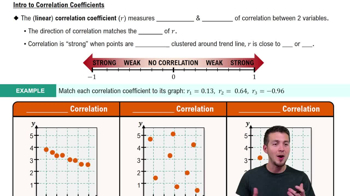
Correlation vs. Causation

Correlation refers to a statistical relationship between two variables, indicating that they change together. However, this does not imply that one variable causes the other. In the context of the study, while weight loss and decreased risk of high blood pressure are correlated, it cannot be concluded that weight loss directly causes the reduction in blood pressure without further evidence.
추천 영상:
가이드 코스
05:43
Correlation Coefficient

Confounding Variables

Confounding variables are external factors that may influence both the independent and dependent variables in a study, potentially leading to misleading conclusions. In this case, factors such as diet, exercise, or genetics could affect both weight loss and blood pressure, making it essential to control for these variables to establish a true causal relationship.
추천 영상:
가이드 코스
07:09
Intro to Random Variables & Probability Distributions

Study Design

The design of a study significantly impacts the validity of its conclusions. Observational studies can identify associations but cannot definitively establish causation. To infer causality, experimental designs, such as randomized controlled trials, are preferred, as they allow for manipulation of the independent variable and control of confounding factors.
추천 영상:
05:50
Critical Values: t-Distribution