
Ch. 1 - Introduction to Statistics
Larson - Elementary Statistics: Picturing the World 8th Edition
Larson8th EditionElementary Statistics: Picturing the WorldISBN: 9780137493470당신이 사용하는 게 아니라요?교과서 변경
1장, 문제 1.1.36

Determine whether the number describes a population parameter or a sample statistic. Explain your reasoning.
A survey of 919 college board members found that 89% think that their institution is a good place for members of racial and ethnic minorities. (Source: Association of Governing Boards of Universities and Colleges)

검증된 단계별 안내
1
Step 1: Understand the definitions of population parameter and sample statistic. A population parameter is a numerical value that describes a characteristic of the entire population, while a sample statistic is a numerical value that describes a characteristic of a subset (sample) of the population.
Step 2: Identify the group being studied in the problem. The survey mentions 919 college board members, which is a subset of all college board members. This indicates that the data is based on a sample rather than the entire population.
Step 3: Analyze the numerical value provided in the problem. The 89% represents the proportion of surveyed college board members who think their institution is a good place for members of racial and ethnic minorities. Since this value is derived from the sample of 919 members, it is a sample statistic.
Step 4: Explain the reasoning. The 89% is not describing the opinion of all college board members (the population); it is based on the responses of the surveyed subset (the sample). Therefore, it is a sample statistic.
Step 5: Conclude that the number provided (89%) is a sample statistic because it is calculated from a sample of 919 college board members rather than the entire population of college board members.

비슷한 문제에 대한 검증된 영상 답변:

이 영상 해법은 위 문제에 도움이 된다고 튜터들이 추천한 것입니다.
영상 길이:
3m
도움이 되었나요?

주요 개념

질문에 올바르게 답하기 위해 반드시 이해해야 하는 핵심 개념들은 다음과 같습니다.

Population Parameter

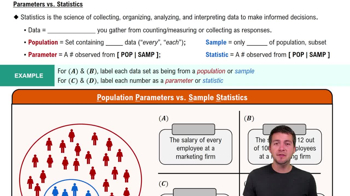
A population parameter is a numerical value that summarizes a characteristic of an entire population. It is a fixed value, often unknown, that represents the true measure of a specific attribute across all individuals in the population. For example, the percentage of all college board members who believe their institution is inclusive would be a population parameter.
추천 영상:
가이드 코스
05:53
Parameters vs. Statistics

Sample Statistic

A sample statistic is a numerical value that summarizes a characteristic of a sample, which is a subset of the population. It is used to estimate the population parameter and can vary from sample to sample. In the given question, the 89% figure derived from the survey of 919 college board members is a sample statistic, as it reflects the opinion of only a portion of the entire population of college board members.
추천 영상:
05:11
Sampling Distribution of Sample Proportion

Sampling and Inference

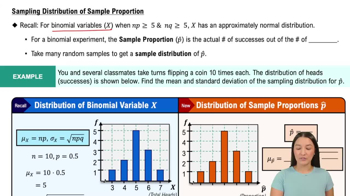
Sampling and inference involve selecting a subset of individuals from a larger population to make generalizations about that population. The process includes collecting data from the sample and using statistical methods to infer characteristics of the population. Understanding this concept is crucial for interpreting the results of the survey and determining whether the reported percentage accurately reflects the views of all college board members.
추천 영상:
05:11
Sampling Distribution of Sample Proportion