Ch. 1 - Introduction to Statistics
Larson - Elementary Statistics: Picturing the World 8th Edition
Larson8th EditionElementary Statistics: Picturing the WorldISBN: 9780137493470당신이 사용하는 게 아니라요?교과서 변경
1장, 문제 1.1.8

Determine whether the statement is true or false. If it is false, rewrite it as a true statement.
Inferential statistics involves using a population to draw a conclusion about a corresponding sample.

검증된 단계별 안내
1
Understand the definition of inferential statistics: Inferential statistics involves using data from a sample to make generalizations or draw conclusions about a population, not the other way around.
Identify the error in the given statement: The statement incorrectly claims that inferential statistics uses a population to draw conclusions about a sample, which is the reverse of its actual purpose.
Rewrite the statement correctly: Inferential statistics involves using a sample to draw conclusions about a corresponding population.
Reflect on the importance of sampling: Explain that sampling is a practical approach because it is often impossible or impractical to collect data from an entire population.
Consider examples of inferential statistics: Examples include hypothesis testing, confidence intervals, and regression analysis, all of which use sample data to infer characteristics of a population.

비슷한 문제에 대한 검증된 영상 답변:

이 영상 해법은 위 문제에 도움이 된다고 튜터들이 추천한 것입니다.
영상 길이:
3m
도움이 되었나요?

주요 개념

질문에 올바르게 답하기 위해 반드시 이해해야 하는 핵심 개념들은 다음과 같습니다.

Inferential Statistics

Inferential statistics is a branch of statistics that allows us to make conclusions about a population based on a sample of data drawn from that population. It involves using probability theory to estimate population parameters, test hypotheses, and make predictions. This contrasts with descriptive statistics, which only summarizes the data at hand.
추천 영상:
가이드 코스
05:53
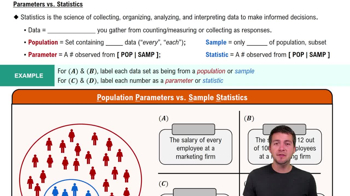
Parameters vs. Statistics

Population vs. Sample

In statistics, a population refers to the entire group of individuals or instances about which we seek to draw conclusions, while a sample is a subset of that population selected for analysis. The goal of inferential statistics is to use the sample data to infer characteristics or behaviors of the larger population, making it crucial to ensure that the sample is representative.
추천 영상:
05:11
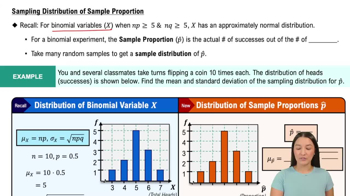
Sampling Distribution of Sample Proportion

True Statement Revision

When a statement is found to be false, it is important to revise it to reflect the correct information. In this context, the original statement incorrectly suggests that inferential statistics uses a population to draw conclusions about a sample, when in fact it is the other way around: inferential statistics uses a sample to make inferences about a population.
추천 영상:
가이드 코스
06:21
Step 1: Write Hypotheses
관련 실천
교과서 질문

Determine whether you would take a census or use a sampling. If you would use a sampling, determine which sampling technique you would use. Explain.

The average distance traveled to a stadium by 55,000 spectators

202
views

교과서 질문

Determine whether the number describes a population parameter or a sample statistic. Explain your reasoning.

Voter registration records show that 47% of all voters in a county are registered as Democrats.

220
views
교과서 질문

A researcher wants to study the effects of sleep deprivation on motor skills. Eighteen people volunteer for the experiment: Jake, Arya, Xavier, Nyla, Shaniece, Chen, Juan, Hana, Nia, Ansel, Liam, Bruno, Mei, Zoey, Kayla, Liam, Sofia, and Kai. Use a random number generator to choose nine subjects for the treatment group. The other nine subjects will go into the control group. List the subjects in each group. Tell which method you used to generate the random numbers.

114
views
교과서 질문

Identify the sampling technique used, and discuss potential sources of bias (if any). Explain.

Soybeans are planted on a 48-acre field. The field is divided into one-acre subplots. A sample is taken from each subplot to estimate the harvest.

218
views
교과서 질문

"Determine the level of measurement of the data set. Explain your reasoning.

The top ten fiction hardcover books on The New York Times Best Sellers List based on sales in the week ending March 6, 2021, are listed. (Source: The New York Times)


1. Life After Death

2. The Four Winds

3. Klara and the Sun

4. Dark Sky

5. The Affair

6. The Midnight Library

7. The Lost Apothecary

8. The Vanishing Half

9. Infinite Country

10. A Court of Silver Flames"

105
views
교과서 질문

What is replication in an experiment? Why is replication important?

466
views