Ch. 1 - Introduction to Statistics
Larson - Elementary Statistics: Picturing the World 8th Edition
Larson8th EditionElementary Statistics: Picturing the WorldISBN: 9780137493470당신이 사용하는 게 아니라요?교과서 변경
1장, 문제 1.Q.7a

Identify the sampling technique used in each study. Explain your reasoning.
A journalist asks people at a campground about air pollution.

검증된 단계별 안내
1
Understand the problem: The task is to identify the sampling technique used in the study and explain the reasoning behind the choice. Sampling techniques include simple random sampling, stratified sampling, cluster sampling, systematic sampling, and convenience sampling.
Analyze the scenario: The journalist is asking people at a campground about air pollution. This means the sample is being drawn from individuals who are conveniently available at the campground.
Identify the sampling technique: Since the journalist is selecting individuals based on their availability and proximity (at the campground), this is an example of convenience sampling.
Explain the reasoning: Convenience sampling is used when the sample is chosen based on ease of access or availability rather than random selection or specific criteria. In this case, the journalist is not randomly selecting individuals or dividing them into groups but is instead relying on the convenience of those present at the campground.
Conclude: The sampling technique used is convenience sampling because the journalist is gathering data from a readily accessible group of people without employing randomization or stratification.

비슷한 문제에 대한 검증된 영상 답변:

이 영상 해법은 위 문제에 도움이 된다고 튜터들이 추천한 것입니다.
영상 길이:
5m
도움이 되었나요?

주요 개념

질문에 올바르게 답하기 위해 반드시 이해해야 하는 핵심 개념들은 다음과 같습니다.

Sampling Techniques

Sampling techniques are methods used to select individuals from a population to participate in a study. These techniques can be broadly categorized into probability sampling, where every individual has a known chance of being selected, and non-probability sampling, where selection is based on subjective judgment. Understanding these techniques is crucial for evaluating the representativeness and validity of study findings.
추천 영상:
05:11
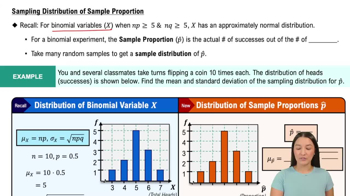
Sampling Distribution of Sample Proportion

Convenience Sampling

Convenience sampling is a non-probability sampling technique where participants are selected based on their easy availability and proximity to the researcher. In the given scenario, the journalist is asking people at a campground, which suggests that the sample is drawn from those who are readily accessible, potentially leading to bias and limiting the generalizability of the results.
추천 영상:
05:11
Sampling Distribution of Sample Proportion

Bias in Sampling

Bias in sampling occurs when certain members of a population are systematically more likely to be selected than others, leading to results that do not accurately reflect the population. In the context of the journalist's study, the choice of a campground as the location may introduce bias, as it may not represent the views of the broader population regarding air pollution, particularly those who do not camp.
추천 영상:
05:11
Sampling Distribution of Sample Proportion