Ch. 3 - Probability
Larson - Elementary Statistics: Picturing the World 8th Edition
Larson8th EditionElementary Statistics: Picturing the WorldISBN: 9780137493470당신이 사용하는 게 아니라요?교과서 변경
3장, 문제 3.4.37

37. Water Pollution An environmental agency is analyzing water samples from 80 lakes for pollution. Five of the lakes have dangerously high levels of dioxin. Six lakes are randomly selected from the sample. Use technology to find how many ways one polluted lake and five nonpolluted lakes can be chosen.

검증된 단계별 안내
1
Step 1: Understand the problem. We are tasked with finding the number of ways to select 1 polluted lake (out of 5) and 5 non-polluted lakes (out of 75) from a total of 80 lakes. This is a combination problem because the order of selection does not matter.
Step 2: Recall the formula for combinations, which is given by: C(n,r)=n!r!(n-r)!, where n is the total number of items, and r is the number of items to choose.
Step 3: Calculate the number of ways to choose 1 polluted lake from the 5 polluted lakes using the combination formula: C(5,1). This represents the number of ways to select 1 polluted lake.
Step 4: Calculate the number of ways to choose 5 non-polluted lakes from the 75 non-polluted lakes using the combination formula: C(75,5). This represents the number of ways to select 5 non-polluted lakes.
Step 5: Multiply the results from Step 3 and Step 4 to find the total number of ways to select 1 polluted lake and 5 non-polluted lakes. The final expression is: C(5,1)×C(75,5).

비슷한 문제에 대한 검증된 영상 답변:

이 영상 해법은 위 문제에 도움이 된다고 튜터들이 추천한 것입니다.
영상 길이:
4m
도움이 되었나요?

주요 개념

질문에 올바르게 답하기 위해 반드시 이해해야 하는 핵심 개념들은 다음과 같습니다.

Combinatorics

Combinatorics is a branch of mathematics dealing with combinations and permutations of objects. In this context, it helps determine the number of ways to select a specific number of items from a larger set, which is essential for calculating how many ways one polluted lake and five nonpolluted lakes can be chosen from the sample.

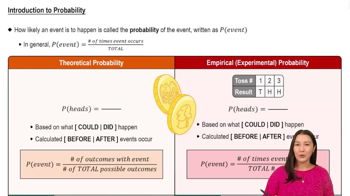
Probability

Probability is the measure of the likelihood that an event will occur. Understanding probability is crucial in this scenario as it allows the environmental agency to assess the chances of selecting a polluted lake among the total lakes sampled, which informs risk assessments related to water pollution.
추천 영상:
5:37
Introduction to Probability

Sampling Techniques

Sampling techniques refer to the methods used to select a subset of individuals or items from a larger population. In this case, the random selection of lakes is a sampling technique that ensures each lake has an equal chance of being chosen, which is important for the validity of the analysis regarding pollution levels.
추천 영상:
05:11
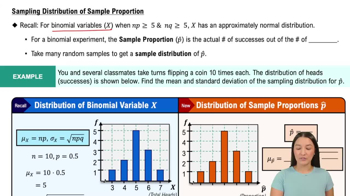
Sampling Distribution of Sample Proportion
관련 실천
교과서 질문

Using the Multiplication Rule In Exercises 19-32, use the Multiplication Rule.

20. Coin and Die A coin is tossed and a die is rolled. Find the probability of tossing a tail and then rolling a number greater than 2.

146
views

교과서 질문

Writing In Exercises 89 and 90, write a statement that represents the complement of the probability.

90. The probability of randomly choosing a car with more than one cause for showing its "CHECK ENGINE" light from the population of vehicles showing "CHECK ENGINE" lights.

103
views
교과서 질문

Classifying Events as Independent or Dependent In Exercises 9-14, determine whether the events are independent or dependent. Explain your reasoning.

14. A ball is selected from a bin of balls numbered from 1 through 52. It is replaced, and then a second numbered ball is selected from the bin.

86
views
교과서 질문

Board of Directors The University of Colorado Board of Directors has 23 members. One member serves as board chair and another serves as vice chair. Given the names of the 23

board members, what is the probability of randomly selecting the name of the chair and the name of the vice chair? (Source: University of Colorado)

79
views
교과서 질문

Using a Frequency Distribution to Find Probabilities In Exercises 49-52, use the frequency distribution at the left, which shows the population of the United States by age group, to find the probability that a U.S. resident chosen at random is in the age range. (Source: U.S. Census Bureau)

52. 65 years old and older

132
views
교과서 질문

Matching Probabilities In Exercises 11-16, match the event with its probability.

a. 0.95

b. 0.005

c. 0.25

d. 0

e. 0.375

f. 0.5

16. You toss a coin four times. What is the probability of tossing tails exactly half of the time?

135
views