Ch. 3 - Probability
Larson - Elementary Statistics: Picturing the World 8th Edition
Larson8th EditionElementary Statistics: Picturing the WorldISBN: 9780137493470당신이 사용하는 게 아니라요?교과서 변경
3장, 문제 3.1.80

80. Unusual Events Can any of the events in Exercises 75-78 be considered unusual? Explain.

검증된 단계별 안내
1
Step 1: Understand the concept of 'unusual events' in statistics. An event is considered unusual if its probability is very low, typically less than 0.05 (5%). This threshold helps identify events that are rare or unexpected.
Step 2: Review the events described in Exercises 75-78. Carefully examine the probabilities associated with each event. If the probabilities are not provided, calculate them using the appropriate formulas or data given in the exercises.
Step 3: Compare the calculated probabilities of each event to the threshold of 0.05. If the probability of an event is less than 0.05, it can be classified as unusual.
Step 4: Provide reasoning for why each event is or is not unusual based on the comparison. For example, if an event has a probability of 0.03, it is unusual because it falls below the threshold. Conversely, if an event has a probability of 0.10, it is not unusual.
Step 5: Summarize your findings for all events in Exercises 75-78, clearly stating which events are unusual and providing explanations for each based on their probabilities.

비슷한 문제에 대한 검증된 영상 답변:

이 영상 해법은 위 문제에 도움이 된다고 튜터들이 추천한 것입니다.
영상 길이:
2m
도움이 되었나요?

주요 개념

질문에 올바르게 답하기 위해 반드시 이해해야 하는 핵심 개념들은 다음과 같습니다.

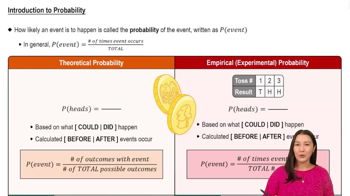
Probability

Probability is a measure of the likelihood that a particular event will occur, expressed as a number between 0 and 1. An event with a probability close to 0 is unlikely to happen, while an event with a probability close to 1 is very likely. Understanding probability is essential for determining whether an event is unusual, as it allows us to quantify how often we expect an event to occur in a given context.
추천 영상:
가이드 코스
5:37
Introduction to Probability

Unusual Events

In statistics, an event is often considered unusual if its probability of occurrence is significantly low, typically defined as less than 5%. This threshold helps to identify events that deviate from what is expected based on historical data or theoretical models. Recognizing unusual events is crucial for making informed decisions and understanding the implications of rare occurrences.
추천 영상:
가이드 코스
05:54
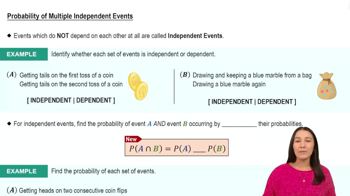
Probability of Multiple Independent Events

Statistical Significance

Statistical significance refers to the likelihood that a relationship or effect observed in data is not due to random chance. It is often assessed using p-values, where a p-value less than 0.05 indicates that the results are statistically significant. This concept is important when evaluating whether the events in Exercises 75-78 can be deemed unusual, as it provides a framework for interpreting the results in a meaningful way.
추천 영상:
가이드 코스
05:53
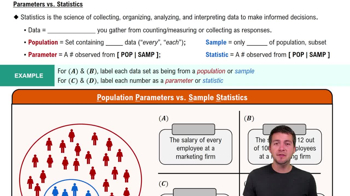
Parameters vs. Statistics