
Ch. 3 - Probability
Larson - Elementary Statistics: Picturing the World 8th Edition
Larson8th EditionElementary Statistics: Picturing the WorldISBN: 9780137493470당신이 사용하는 게 아니라요?교과서 변경
3장, 문제 3.R.46

In Exercises 45-48, use combinations and permutations.
46. Five players on a basketball team must each choose one of the five players on the opposing team to defend. In how many ways can the players choose their defensive assignments?

검증된 단계별 안내
1
Step 1: Recognize that this is a permutations problem because the order in which the defensive assignments are made matters. Each player on the basketball team is assigned to defend a specific player on the opposing team.
Step 2: Recall the formula for permutations, which is used when the order of selection matters. The formula is P(n, r) = n! / (n - r)!, where n is the total number of items to choose from, and r is the number of items being chosen.
Step 3: In this problem, there are 5 players on the basketball team and 5 players on the opposing team. Since all 5 players are being assigned, n = 5 and r = 5. Substitute these values into the permutation formula: P(5, 5) = 5! / (5 - 5)!.
Step 4: Simplify the expression. The factorial of 5 (5!) is calculated as 5 × 4 × 3 × 2 × 1. The factorial of 0 (0!) is defined as 1. Therefore, P(5, 5) = 5! / 1.
Step 5: Conclude that the total number of ways the players can choose their defensive assignments is equal to the value of 5!. This represents the number of permutations of 5 players.

비슷한 문제에 대한 검증된 영상 답변:

이 영상 해법은 위 문제에 도움이 된다고 튜터들이 추천한 것입니다.
영상 길이:
1m
도움이 되었나요?

주요 개념

질문에 올바르게 답하기 위해 반드시 이해해야 하는 핵심 개념들은 다음과 같습니다.

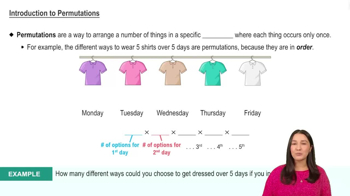
Permutations

Permutations refer to the different arrangements of a set of items where the order matters. In the context of the basketball question, each player choosing a defender from the opposing team represents a unique arrangement, as the specific choice of defender by each player affects the overall assignment.
추천 영상:
07:11
Introduction to Permutations

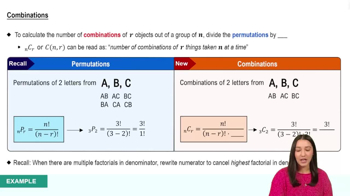
Combinations

Combinations involve selecting items from a larger set where the order does not matter. While the basketball scenario primarily deals with permutations, understanding combinations is essential for grasping how selections can be made without regard to the order of choices, which can be relevant in different contexts.
추천 영상:
05:22
Combinations

Factorial

Factorial, denoted as n!, is the product of all positive integers up to n. It is a fundamental concept in counting arrangements and is used to calculate the total number of ways to arrange or select items. In the basketball problem, factorials help determine the total number of unique defensive assignments based on the players' choices.
추천 영상:
05:22
Combinations
관련 실천
교과서 질문

"In Exercises 5 and 6, use the Fundamental Counting Principle.

5. A student must choose from seven classes to take at 8:00 A.M., four classes to take at 9:00 A.M., and three classes to take at 10:00 A.M. How many ways can the student arrange the schedule?"

54
views
교과서 질문

"In Exercises 1-4, identify the sample space of the probability experiment and determine the number of outcomes in the event. Draw a tree diagram when appropriate.

1. Experiment: Tossing four coins

Event: Getting three heads"

93
views
교과서 질문

"In Exercises 1-4, identify the sample space of the probability experiment and determine the number of outcomes in the event. Draw a tree diagram when appropriate.

4. Experiment: Guessing the gender(s) of the three children in a family

Event: Guessing that the family has two boys"

100
views
교과서 질문

In Exercises 49-53, use counting principles to find the probability.

50. A security code consists of three letters and one digit. The first letter cannot be A, B, or C. What is the probability of guessing the security code on the first try?

87
views
교과서 질문

In Exercises 49-53, use counting principles to find the probability.

52. A class of 40 students takes a statistics exam. The results are shown in the table at the left. Three students are selected at random. What is the probability that

d. all three students received a B or a C?

66
views
교과서 질문

In Exercises 49-53, use counting principles to find the probability.

52. A class of 40 students takes a statistics exam. The results are shown in the table at the left. Three students are selected at random. What is the probability that

b. all three students received a C or better?

111
views