
Ch. 3 - Probability
Larson - Elementary Statistics: Picturing the World 8th Edition
Larson8th EditionElementary Statistics: Picturing the WorldISBN: 9780137493470당신이 사용하는 게 아니라요?교과서 변경
3장, 문제 3.R.48

In Exercises 45-48, use combinations and permutations.
48. An employer must hire 2 people from a list of 13 applicants. In how many ways can the employer choose to hire the two people?

검증된 단계별 안내
1
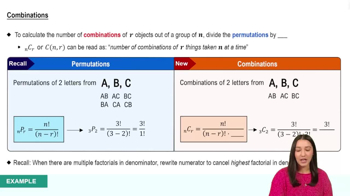
Step 1: Recognize that the problem involves selecting 2 people from a group of 13 without regard to the order in which they are chosen. This indicates that the problem involves combinations, not permutations.
Step 2: Recall the formula for combinations, which is given by: C(n,r)=n!r!(n-r)!, where n is the total number of items (applicants in this case), and r is the number of items to choose (2 people in this case).
Step 3: Substitute the values n=13 and r=2 into the formula: C(13,2)=13!2!(13-2)!.
Step 4: Simplify the factorials in the formula. Start by calculating 13!, 2!, and 11!. Then cancel out the common terms in the numerator and denominator.
Step 5: Perform the division to find the total number of ways the employer can choose 2 people from 13 applicants. The result will be the value of C(13,2).

비슷한 문제에 대한 검증된 영상 답변:

이 영상 해법은 위 문제에 도움이 된다고 튜터들이 추천한 것입니다.
영상 길이:
2m
도움이 되었나요?

주요 개념

질문에 올바르게 답하기 위해 반드시 이해해야 하는 핵심 개념들은 다음과 같습니다.

Combinations

Combinations refer to the selection of items from a larger set where the order of selection does not matter. In this context, when hiring 2 people from 13 applicants, we are interested in how many unique groups of 2 can be formed, regardless of the order in which they are chosen.
추천 영상:
05:22
Combinations

Factorial

The factorial of a non-negative integer n, denoted as n!, is the product of all positive integers up to n. Factorials are essential in calculating combinations and permutations, as they help determine the total arrangements of items. For example, 5! equals 5 × 4 × 3 × 2 × 1 = 120.
추천 영상:
05:22
Combinations

Binomial Coefficient

The binomial coefficient, often represented as C(n, k) or n choose k, quantifies the number of ways to choose k items from n items without regard to the order of selection. It is calculated using the formula C(n, k) = n! / (k!(n-k)!), which is crucial for solving the hiring problem by determining how many ways 2 applicants can be selected from 13.
추천 영상:
가이드 코스
06:14
Coefficient of Determination
관련 실천
교과서 질문

In Exercises 17 and 18, use the table, which shows the numbers of first-time and repeat U.S. nursing students taking the National Council Licensure Examination (NCLEX-RN® exam) to pass or fail in a recent year. (Adapted from National Council Licensure Examinations)

17. Find the probability that a student took the exam for the first time, given that the student failed.

58
views
교과서 질문

In Exercises 7-12, classify the statement as an example of classical probability, empirical probability, or subjective probability. Explain your reasoning.

11. The probability of rolling 2 six-sided dice and getting a sum of 9 is 1/9.

137
views
교과서 질문

"In Exercises 17 and 18, use the table, which shows the numbers of first-time and repeat U.S. nursing students taking the National Council Licensure Examination (NCLEX-RN® exam) to pass or fail in a recent year. (Adapted from National Council Licensure Examinations)

18. Find the probability that a student passed, given that the student repeated the exam."

75
views
교과서 질문

In Exercises 49-53, use counting principles to find the probability.

50. A security code consists of three letters and one digit. The first letter cannot be A, B, or C. What is the probability of guessing the security code on the first try?

87
views
교과서 질문

In Exercises 49-53, use counting principles to find the probability.

52. A class of 40 students takes a statistics exam. The results are shown in the table at the left. Three students are selected at random. What is the probability that

d. all three students received a B or a C?

66
views
교과서 질문

In Exercises 49-53, use counting principles to find the probability.

53. A corporation has six male senior executives and four female senior executives. Four senior executives are chosen at random to attend a technology seminar. What is the

probability of choosing

b. four women?

77
views