Ch. 3 - Probability
Larson - Elementary Statistics: Picturing the World 8th Edition
Larson8th EditionElementary Statistics: Picturing the WorldISBN: 9780137493470당신이 사용하는 게 아니라요?교과서 변경
3장, 문제 3.3.10

Recognizing Mutually Exclusive Events In Exercises 9–12, determine whether the events are mutually exclusive. Explain your reasoning.
10. Event A: Randomly select a student with a birthday in April.
Event B: Randomly select a student with a birthday in May.

검증된 단계별 안내
1
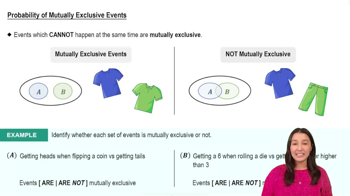
Understand the concept of mutually exclusive events: Two events are mutually exclusive if they cannot occur at the same time. In other words, the occurrence of one event means the other cannot happen.
Identify the two events in the problem: Event A is selecting a student with a birthday in April, and Event B is selecting a student with a birthday in May.
Analyze whether the two events can occur simultaneously: A student cannot have a birthday in both April and May at the same time. Therefore, the two events cannot overlap.
Conclude that the events are mutually exclusive: Since it is impossible for a student to have a birthday in both April and May, the events are mutually exclusive.
Explain the reasoning: The events are mutually exclusive because the occurrence of one event (a birthday in April) excludes the possibility of the other event (a birthday in May).

비슷한 문제에 대한 검증된 영상 답변:

이 영상 해법은 위 문제에 도움이 된다고 튜터들이 추천한 것입니다.
영상 길이:
2m
도움이 되었나요?

주요 개념

질문에 올바르게 답하기 위해 반드시 이해해야 하는 핵심 개념들은 다음과 같습니다.

Mutually Exclusive Events

Mutually exclusive events are those that cannot occur at the same time. In probability, if one event happens, the other cannot. For example, if you roll a die, getting a 3 and getting a 5 are mutually exclusive because both outcomes cannot happen simultaneously.
추천 영상:
5:14
Probability of Mutually Exclusive Events

Sample Space

The sample space is the set of all possible outcomes of a random experiment. In the context of selecting a student based on their birthday, the sample space would include all months of the year. Understanding the sample space helps in determining the relationships between different events.
추천 영상:
05:11
Sampling Distribution of Sample Proportion

Probability

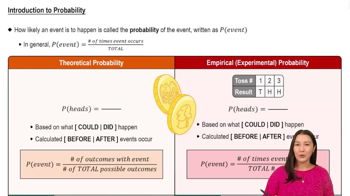
Probability is a measure of the likelihood that an event will occur, expressed as a number between 0 and 1. In the case of mutually exclusive events, the probability of either event occurring is the sum of their individual probabilities. This concept is essential for analyzing the likelihood of events in statistical scenarios.
추천 영상:
5:37
Introduction to Probability
관련 실천
교과서 질문

Cards In Exercises 59-62, you are dealt a hand of five cards from a standard deck of 52 playing cards.

62. Find the probability of being dealt three of a kind (the other two cards are different from each other).

146
views

교과서 질문

Boy or Girl? In Exercises 71-74, a couple plans to have three children. Each child is equally likely to be a boy or a girl.

74. What is the probability that at least one child is a boy?

111
views
교과서 질문

Matching Probabilities In Exercises 11-16, match the event with its probability.

a. 0.95

b. 0.005

c. 0.25

d. 0

e. 0.375

f. 0.5

14. A game show contestant must randomly select a door. One door doubles her money while the other three doors leave her with no winnings. What is the probability she selects the

door that doubles her money?

77
views
교과서 질문

Classifying Types of Probability In Exercises 53-58, classify the statement as an example of classical probability, empirical probability, or subjective probability. Explain your reasoning.

55. An analyst feels that the probability of a team winning an upcoming game is 60%.

114
views
교과서 질문

Finding the Probability of the Complement of an Event The age distribution of the residents of Ithaca, New York, is shown at the left. In Exercises 59-62, find the probability of the event. (Source: U.S. Census Bureau)

61. Event C: A randomly chosen resident of Ithaca is not less than 18 years old.

128
views
교과서 질문

Finding the Probability of the Complement of an Event In Exercises 17-20, the probability that an event will happen is given. Find the probability that the event will not happen.

19. P(E)=0.03

287
views