
Ch. 3 - Probability
Larson - Elementary Statistics: Picturing the World 8th Edition
Larson8th EditionElementary Statistics: Picturing the WorldISBN: 9780137493470당신이 사용하는 게 아니라요?교과서 변경
3장, 문제 3.4.43a

Shuffle Play You use a shuffle playback feature to randomly play songs in a playlist. The playlist of 56 songs includes 15 instrumental songs.
a. What is the probability that the first three songs to play are instrumental songs? (Assume a song cannot be repeated.)

검증된 단계별 안내
1
Step 1: Understand the problem. We are tasked with finding the probability that the first three songs played from a playlist of 56 songs (15 of which are instrumental) are all instrumental. Since songs cannot be repeated, this is a problem involving dependent probabilities.
Step 2: Recall the formula for probability. The probability of multiple dependent events occurring is the product of their individual probabilities. For this problem, the probability of selecting an instrumental song changes after each selection because the total number of songs and the number of instrumental songs both decrease.
Step 3: Calculate the probability of the first song being instrumental. The probability is the ratio of the number of instrumental songs to the total number of songs: \( P(\text{First song instrumental}) = \frac{15}{56} \).
Step 4: Calculate the probability of the second song being instrumental, given that the first song was instrumental. After one instrumental song is played, there are 14 instrumental songs left and 55 songs in total: \( P(\text{Second song instrumental | First song instrumental}) = \frac{14}{55} \).
Step 5: Calculate the probability of the third song being instrumental, given that the first two songs were instrumental. After two instrumental songs are played, there are 13 instrumental songs left and 54 songs in total: \( P(\text{Third song instrumental | First two songs instrumental}) = \frac{13}{54} \). Multiply these probabilities together to find the overall probability: \( P(\text{All three songs instrumental}) = \frac{15}{56} \times \frac{14}{55} \times \frac{13}{54} \).

비슷한 문제에 대한 검증된 영상 답변:

이 영상 해법은 위 문제에 도움이 된다고 튜터들이 추천한 것입니다.
영상 길이:
4m
도움이 되었나요?

주요 개념

질문에 올바르게 답하기 위해 반드시 이해해야 하는 핵심 개념들은 다음과 같습니다.

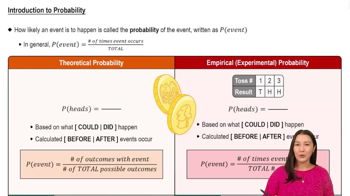
Probability

Probability is a measure of the likelihood that a particular event will occur, expressed as a number between 0 and 1. In this context, it quantifies the chance of selecting instrumental songs from a playlist. The probability of an event can be calculated by dividing the number of favorable outcomes by the total number of possible outcomes.
추천 영상:
5:37
Introduction to Probability

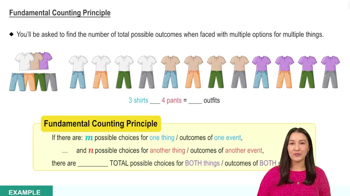
Combinatorial Counting

Combinatorial counting involves determining the number of ways to choose or arrange items from a set. In this scenario, it is essential to calculate how many ways the first three songs can be selected from the 15 instrumental songs out of the total 56. This concept helps in understanding how to compute probabilities in situations where order matters.
추천 영상:
04:04
Fundamental Counting Principle

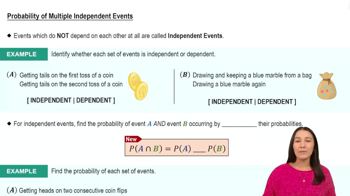
Dependent Events

Dependent events are events where the outcome of one event affects the outcome of another. In this question, the selection of the first song influences the available choices for the second and third songs, as songs cannot be repeated. Understanding this concept is crucial for accurately calculating the probability of sequential events.
추천 영상:
05:54
Probability of Multiple Independent Events
관련 실천
교과서 질문

"Using the Multiplication Rule In Exercises 19-32, use the Multiplication Rule.

28. Blood Types The probability that a Latinx American person in the United States has type A+ blood is 29%. Four Latinx American people in the United States are selected at random. (Source: American National Red Cross)

a. Find the probability that all four have type A+ blood."

85
views
교과서 질문

26. Eye Survey The table shows the results of a survey that asked 3203 people whether they wore contacts or glasses. A person is selected at random from the sample. Find the probability of each event.

a. The person wears only contacts or only glasses.

" style="" width="480">

91
views
교과서 질문

Using the Multiplication Rule In Exercises 19-32, use the Multiplication Rule.

24. Knowing a Person Who Was Murdered In a sample of 11,771 children ages 2 to 17, 8% have lost a friend or relative to murder. Four children are selected at random. (Adapted from University of New Hampshire)

a. Find the probability that all four have lost a friend or relative to murder.

113
views
교과서 질문

Using the Multiplication Rule In Exercises 19-32, use the Multiplication Rule.

29. In Vitro Fertilization In a recent year, about 1.9% of all infants born in the U.S. were conceived through assisted reproductive technology (ART). Of the ART deliveries, about 26.4% resulted in multiple births. (Source: Morbidity and Mortality Weekly Report)

a. Find the probability that a randomly selected infant was conceived through ART and was part of a multiple birth.

88
views
교과서 질문

Using the Multiplication Rule In Exercises 19-32, use the Multiplication Rule.

23. Celebrities as Role Models In a sample of 1103 probable voters, three out of four say they would like entertainers to address social and political issues. Two probable voters are selected at random. (Source: The Hollywood Reporter)

a. Find the probability that both probable voters would like entertainers to address social and political issues.

126
views
교과서 질문

"Using the Multiplication Rule In Exercises 19-32, use the Multiplication Rule.

27. Blood Types The probability that a person of Asian descent in the United States has type O+ blood is 39%. At random, six people of Asian descent in the United States are selected. (Source: American National Red Cross)

a. Find the probability that all six have type O+ blood."

53
views