
Ch. 4 - Discrete Probability Distributions
Larson - Elementary Statistics: Picturing the World 8th Edition
Larson8th EditionElementary Statistics: Picturing the WorldISBN: 9780137493470당신이 사용하는 게 아니라요?교과서 변경
4장, 문제 4.T.3a

Determine whether the distribution is a probability distribution. If it is not a probability distribution, explain why.
Table displaying values of x and their corresponding probabilities p(x) for discrete random variables.

검증된 단계별 안내
1
Step 1: Recall the conditions for a probability distribution. A probability distribution must satisfy two criteria: (1) Each probability value, p(x), must be between 0 and 1 inclusive, and (2) The sum of all probability values must equal 1.
Step 2: Check the first condition. Inspect each value of p(x) in the table to ensure that all values are between 0 and 1 inclusive. Specifically, verify that 0 ≤ p(x) ≤ 1 for each value.
Step 3: Check the second condition. Add all the values of p(x) from the table: 0.03 + 0.09 + 0.19 + 0.32 + 0.37. Ensure that the sum equals 1.
Step 4: If any p(x) value is outside the range [0, 1], or if the sum of p(x) values does not equal 1, then the distribution is not a probability distribution. Identify and explain the specific issue.
Step 5: If both conditions are satisfied, conclude that the given distribution is a valid probability distribution.

비슷한 문제에 대한 검증된 영상 답변:

이 영상 해법은 위 문제에 도움이 된다고 튜터들이 추천한 것입니다.
영상 길이:
3m
도움이 되었나요?

주요 개념

질문에 올바르게 답하기 위해 반드시 이해해야 하는 핵심 개념들은 다음과 같습니다.

Probability Distribution

A probability distribution describes how the probabilities are distributed over the values of a random variable. For a discrete random variable, it assigns a probability to each possible value, ensuring that the sum of all probabilities equals 1. This concept is fundamental in determining whether a given set of probabilities constitutes a valid probability distribution.
추천 영상:
가이드 코스
06:39
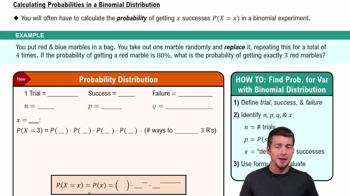
Calculating Probabilities in a Binomial Distribution

Properties of Probability

The properties of probability state that each probability must be between 0 and 1, inclusive, and the total probability of all outcomes must sum to 1. If any probability is negative or if the total does not equal 1, the distribution is invalid. Understanding these properties is essential for evaluating whether the provided probabilities form a legitimate probability distribution.
추천 영상:
5:37
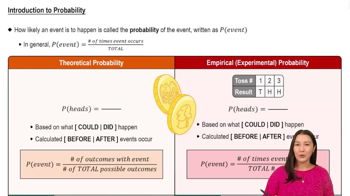
Introduction to Probability

Discrete Random Variables

Discrete random variables are those that can take on a countable number of distinct values, often represented in a table format. Each value has an associated probability, and the analysis of these variables often involves checking the validity of their probability distributions. Recognizing the nature of discrete random variables is crucial for interpreting the data presented in the question.
추천 영상:
가이드 코스
04:48
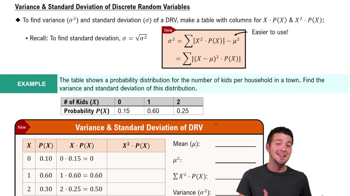
Variance & Standard Deviation of Discrete Random Variables
관련 실천
교과서 질문

In Exercises 1–7, consider a grocery store that can process a total of four customers at its checkout counters each minute.

The mean increases to five arrivals per minute, but the store can still process only four per minute. Generate a list of 20 random numbers with a Poisson distribution for mu = 5 . Then create a table that shows the number of customers waiting at the end of 20 minutes.

89
views
교과서 질문

Using a Distribution to Find Probabilities In Exercises 11–26, find the indicated probabilities using the geometric distribution, the Poisson distribution, or the binomial distribution. Then determine whether the events are unusual. If convenient, use a table or technology to find the probabilities.


Oil Tankers In the month of June 2021, 240 oil tankers stop at a port city. No oil tanker visits more than once. Find the probability that the number of oil tankers that stop on any given day in June is (a) exactly eight

97
views
교과서 질문

In Exercises 1–7, consider a grocery store that can process a total of four customers at its checkout counters each minute.

The mean number of arrivals per minute is four. Find the probability that

c. one customer is waiting in line after one minute and no customers are waiting in line after the second minute..

95
views
교과서 질문

Finding Probabilities Use the probability distribution you made in Exercise 19 to find the probability of randomly selecting a household that has (a) one or two HD televisions

91
views
교과서 질문

The table shows the ages of students in a freshman orientation course.

a. Construct a probability distribution.

118
views
교과서 질문

In Exercises 1–7, consider a grocery store that can process a total of four customers at its checkout counters each minute.

The mean number of customers who arrive at the checkout counters each minute is 4. Create a Poisson distribution with mu = 4 for x = 0 to 20. Compare your results with the histogram shown at the upper right.

71
views