Ch. 4 - Discrete Probability Distributions
Larson - Elementary Statistics: Picturing the World 8th Edition
Larson8th EditionElementary Statistics: Picturing the WorldISBN: 9780137493470당신이 사용하는 게 아니라요?교과서 변경
4장, 문제 4.2.15

Identifying and Understanding Binomial Experiments In Exercises 15–18, determine whether the experiment is a binomial experiment. If it is, identify a success; specify the values of n, p, and q; and list the possible values of the random variable x. If it is not a binomial experiment, explain why.


Video Games A survey found that 29% of gamers own a virtual reality (VR) device. Ten gamers are randomly selected. The random variable represents the number who own a VR device. (Source: Entertainment Software Association)

검증된 단계별 안내
1
Step 1: Recall the criteria for a binomial experiment. A binomial experiment must satisfy the following conditions: (1) The experiment consists of a fixed number of trials, n. (2) Each trial has only two possible outcomes: success or failure. (3) The probability of success, p, is the same for each trial. (4) The trials are independent of each other.
Step 2: Analyze the given problem. The experiment involves selecting 10 gamers (fixed number of trials, n = 10). Each gamer either owns a VR device (success) or does not own a VR device (failure), satisfying the two-outcome condition. The probability of success (owning a VR device) is given as p = 0.29, and the probability of failure is q = 1 - p = 0.71. The trials are independent because the ownership of a VR device by one gamer does not affect another.
Step 3: Conclude that this is a binomial experiment because it satisfies all four conditions of a binomial experiment: fixed number of trials, two outcomes per trial, constant probability of success, and independence of trials.
Step 4: Identify the success, n, p, q, and the possible values of the random variable x. Success is defined as a gamer owning a VR device. The number of trials is n = 10. The probability of success is p = 0.29, and the probability of failure is q = 0.71. The random variable x represents the number of gamers who own a VR device, and its possible values are x = 0, 1, 2, ..., 10.
Step 5: Summarize the findings. This is a binomial experiment with n = 10, p = 0.29, q = 0.71, and the possible values of x ranging from 0 to 10. If the experiment did not meet the binomial criteria, you would explain which condition(s) were violated.

비슷한 문제에 대한 검증된 영상 답변:

이 영상 해법은 위 문제에 도움이 된다고 튜터들이 추천한 것입니다.
영상 길이:
3m
도움이 되었나요?

주요 개념

질문에 올바르게 답하기 위해 반드시 이해해야 하는 핵심 개념들은 다음과 같습니다.

Binomial Experiment

A binomial experiment is a statistical experiment that meets four criteria: it consists of a fixed number of trials, each trial has two possible outcomes (success or failure), the trials are independent, and the probability of success remains constant across trials. In this context, the experiment involves selecting a fixed number of gamers and determining how many own a VR device.
추천 영상:
가이드 코스
06:00
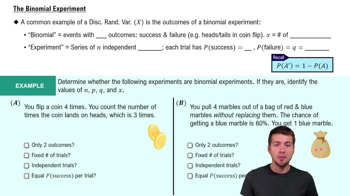
The Binomial Experiment

Random Variable

A random variable is a numerical outcome of a random phenomenon. In binomial experiments, the random variable typically represents the number of successes in the fixed number of trials. For the given question, the random variable x represents the number of gamers out of ten who own a VR device, which can take on values from 0 to 10.
추천 영상:
가이드 코스
07:09
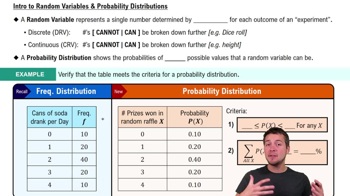
Intro to Random Variables & Probability Distributions

Probability Parameters (n, p, q)

In a binomial experiment, 'n' represents the number of trials, 'p' is the probability of success on each trial, and 'q' is the probability of failure, where q = 1 - p. For the survey of gamers, n is 10 (the number of gamers selected), p is 0.29 (the probability that a gamer owns a VR device), and q is 0.71 (the probability that a gamer does not own a VR device).
추천 영상:
5:37
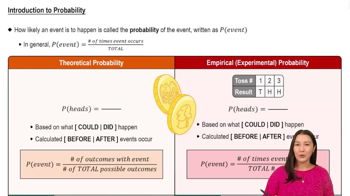
Introduction to Probability
관련 실천
교과서 질문

The five-year survival rate of people who undergo a liver transplant is 75%. The surgery is performed on six patients. (Source: Mayo Clinic)

b. Graph the binomial distribution using a histogram and describe its shape.

75
views

교과서 질문

Identifying and Understanding Binomial Experiments In Exercises 15–18, determine whether the experiment is a binomial experiment. If it is, identify a success; specify the values of n, p, and q; and list the possible values of the random variable x. If it is not a binomial experiment, explain why.


Basketball A’ja Wilson, the 2020 WNBA Most Valuable Player, makes a free throw shot about 78% of the time. The random variable represents the number of free throws that she makes on eight attempts. (Source: Women’s National Basketball Association)

165
views
교과서 질문

Constructing and Graphing Binomial Distributions In Exercises 27–30, (a) construct a binomial distribution, (b) graph the binomial distribution using a histogram and describe its shape, and (c) identify any values of the random variable x that you would consider unusual. Explain your reasoning.


College Acceptance Pennsylvania State University accepts 49% of applicants. You randomly select seven Pennsylvania State University applicants. The random variable represents the number who are accepted. (Source: US News & World Report)

133
views
교과서 질문

An online magazine finds that the mean number of typographical errors per page is five. Find the probability that the number of typographical errors found on any given page is (a) exactly five, (b) less than five, and (c) exactly zero.

108
views
교과서 질문

Discrete Variables and Continuous Variables In Exercises 13–18, determine whether the random variable x is discrete or continuous. Explain.


Let x represent the length of time it takes to complete an exam.

63
views
교과서 질문

Finding the Mean, Variance, and Standard Deviation In Exercises 29–34, (a) find the mean, variance, and standard deviation of the probability distribution, and (b) interpret the results.

Machine Parts The number of defects per 1000 machine parts inspected

84
views