
Ch. 4 - Discrete Probability Distributions
Larson - Elementary Statistics: Picturing the World 8th Edition
Larson8th EditionElementary Statistics: Picturing the WorldISBN: 9780137493470당신이 사용하는 게 아니라요?교과서 변경
4장, 문제 4.R.1

In Exercises 1 and 2, determine whether the random variable x is discrete or continuous. Explain.


Let x represent the grade on an exam worth a total of 100 points.

검증된 단계별 안내
1
Understand the definitions: A discrete random variable takes on a countable number of distinct values, while a continuous random variable can take on any value within a given range, including fractions and decimals.
Identify the nature of the variable x: The grade on an exam worth a total of 100 points is typically expressed as a whole number (e.g., 85, 90, etc.), which suggests it is countable.
Consider whether fractional values are possible: If grades are rounded to whole numbers, x is discrete. However, if fractional grades (e.g., 85.5) are allowed, x could be continuous.
Determine the context: In most grading systems, grades are reported as whole numbers, making x a discrete random variable.
Explain the conclusion: Since the grade is typically a countable value and does not take on an infinite range of possibilities within an interval, x is classified as a discrete random variable.

비슷한 문제에 대한 검증된 영상 답변:

이 영상 해법은 위 문제에 도움이 된다고 튜터들이 추천한 것입니다.
영상 길이:
2m
도움이 되었나요?

주요 개념

질문에 올바르게 답하기 위해 반드시 이해해야 하는 핵심 개념들은 다음과 같습니다.

Discrete Random Variable

A discrete random variable is one that can take on a countable number of distinct values. Examples include the number of students in a class or the outcome of rolling a die. In the context of grades, if we consider only whole number scores (0, 1, 2, ..., 100), the variable is discrete because it cannot take on values like 75.5.
추천 영상:
가이드 코스
04:48
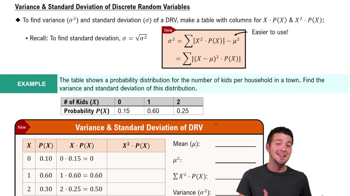
Variance & Standard Deviation of Discrete Random Variables

Continuous Random Variable

A continuous random variable can take on an infinite number of values within a given range. This means it can represent measurements that can be infinitely divided, such as height or weight. If grades were measured with decimals (e.g., 75.5), then the variable would be considered continuous, as it could take any value within the range of possible scores.
추천 영상:
가이드 코스
07:09
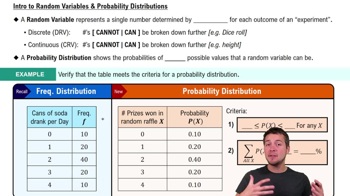
Intro to Random Variables & Probability Distributions

Random Variable

A random variable is a numerical outcome of a random phenomenon. It can be classified as either discrete or continuous based on the nature of its possible values. Understanding whether a random variable is discrete or continuous is crucial for selecting appropriate statistical methods for analysis, such as probability distributions.
추천 영상:
가이드 코스
07:09
Intro to Random Variables & Probability Distributions
관련 실천
교과서 질문

In Exercises 21–26, find the indicated probabilities using the geometric distribution, the Poisson distribution, or the binomial distribution. Then determine whether the events are unusual. If convenient, use a table or technology to find the probabilities

Thirty-six percent of Americans think there is still a need for the practice of changing their clocks for Daylight Savings Time. You randomly select seven Americans. Find the probability that the number who say there is still a need for changing their clocks for Daylight Savings Time is (c) at least six.

92
views
교과서 질문

The five-year survival rate of people who undergo a liver transplant is 75%. The surgery is performed on six patients. (Source: Mayo Clinic)

a. Construct a binomial distribution.

114
views
교과서 질문

In Exercises 21–26, find the indicated probabilities using the geometric distribution, the Poisson distribution, or the binomial distribution. Then determine whether the events are unusual. If convenient, use a table or technology to find the probabilities.

Fourteen percent of noninstitutionalized U.S. adults smoke cigarettes. After randomly selecting ten noninstitutionalized U.S. adults, you ask them whether they smoke cigarettes. Find the probability that the first adult who smokes cigarettes is (c) not one of the first six persons selected.

77
views
교과서 질문

In Exercises 21–26, find the indicated probabilities using the geometric distribution, the Poisson distribution, or the binomial distribution. Then determine whether the events are unusual. If convenient, use a table or technology to find the probabilities

Thirty-six percent of Americans think there is still a need for the practice of changing their clocks for Daylight Savings Time. You randomly select seven Americans. Find the probability that the number who say there is still a need for changing their clocks for Daylight Savings Time is (b) less than two

98
views
교과서 질문

The table lists the number of wireless devices per household in a small town in the United States.

c. Find the mean, variance, and standard deviation of the probability distribution and interpret the results.

88
views
교과서 질문

The table lists the number of wireless devices per household in a small town in the United States.

a. Construct a probability distribution.

96
views