
Ch. 4 - Discrete Probability Distributions
Larson - Elementary Statistics: Picturing the World 8th Edition
Larson8th EditionElementary Statistics: Picturing the WorldISBN: 9780137493470당신이 사용하는 게 아니라요?교과서 변경
4장, 문제 4.T.1a

In Exercises 1–3, find the indicated probabilities using the geometric distribution, the Poisson distribution, or the binomial distribution. Then determine whether the events are unusual. If convenient, use a table or technology to find the probabilities.
One out of every 42 tax returns for incomes over \$1 million requires an audit. An auditor is examining tax returns for over \$1 million. Find the probability that (a) the first return requiring an audit is the 25th return the tax auditor examines, (b) the first return requiring an audit is the first or second return the tax auditor examines, and (c) none of the first five returns the tax auditor examines require an audit. (Source: Kiplinger)

검증된 단계별 안내
1
Step 1: Identify the type of probability distribution to use. Since the problem involves finding the probability of the first success (audit) occurring on a specific trial or within a certain number of trials, the geometric distribution is appropriate. The geometric distribution models the number of trials until the first success in a sequence of independent Bernoulli trials.
Step 2: Define the parameters of the geometric distribution. The probability of success (p) is given as 1/42 (since one out of every 42 tax returns requires an audit). The probability of failure (q) is therefore 1 - p = 41/42.
Step 3: Solve part (a). To find the probability that the first return requiring an audit is the 25th return, use the probability mass function (PMF) of the geometric distribution: P(X = k) = q^(k-1) * p, where k is the trial number of the first success. Substitute k = 25, p = 1/42, and q = 41/42 into the formula.
Step 4: Solve part (b). To find the probability that the first return requiring an audit is the first or second return, calculate P(X = 1) + P(X = 2). Use the PMF formula for each value of k (k = 1 and k = 2), and then sum the results.
Step 5: Solve part (c). To find the probability that none of the first five returns require an audit, calculate the probability of five consecutive failures. This is given by q^5, where q = 41/42. Substitute the value of q into the formula and compute q^5.

비슷한 문제에 대한 검증된 영상 답변:

이 영상 해법은 위 문제에 도움이 된다고 튜터들이 추천한 것입니다.
영상 길이:
2m
도움이 되었나요?

주요 개념

질문에 올바르게 답하기 위해 반드시 이해해야 하는 핵심 개념들은 다음과 같습니다.

Geometric Distribution

The geometric distribution models the number of trials needed to achieve the first success in a series of independent Bernoulli trials. In this context, it is used to find the probability that the first tax return requiring an audit occurs on a specific trial, such as the 25th return examined. The probability of success (an audit) is constant, making this distribution suitable for the problem.
추천 영상:
가이드 코스
06:38
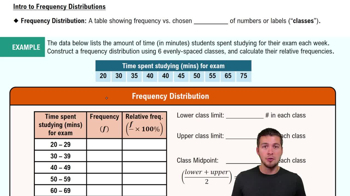
Intro to Frequency Distributions

Poisson Distribution

The Poisson distribution is used to model the number of events occurring within a fixed interval of time or space, given a known average rate of occurrence. While not directly applicable to the specific questions posed, understanding this distribution is essential for scenarios where events happen independently and at a constant average rate, such as audits in tax returns over time.
추천 영상:
가이드 코스
06:38
Intro to Frequency Distributions

Binomial Distribution

The binomial distribution describes the number of successes in a fixed number of independent Bernoulli trials, each with the same probability of success. In this case, it can be used to determine the probability of a certain number of audits occurring within a set of tax returns examined, providing a framework for evaluating the likelihood of unusual events based on the defined parameters.
추천 영상:
가이드 코스
03:28
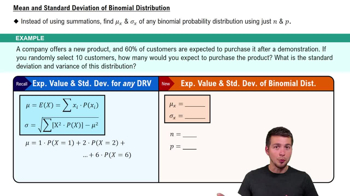
Mean & Standard Deviation of Binomial Distribution
관련 실천
교과서 질문

In Exercises 1–7, consider a grocery store that can process a total of four customers at its checkout counters each minute.

The mean increases to five arrivals per minute, but the store can still process only four per minute. Generate a list of 20 random numbers with a Poisson distribution for mu = 5 . Then create a table that shows the number of customers waiting at the end of 20 minutes.

89
views
교과서 질문

In Exercises 1–7, consider a grocery store that can process a total of four customers at its checkout counters each minute.

The mean number of arrivals per minute is four. Find the probability that

a. three, four, or five customers will arrive during the third minute.

93
views
교과서 질문

In Exercises 1–7, consider a grocery store that can process a total of four customers at its checkout counters each minute.

The mean number of arrivals per minute is four. Find the probability that

c. one customer is waiting in line after one minute and no customers are waiting in line after the second minute..

95
views
교과서 질문

In Exercises 1–3, find the indicated probabilities using the geometric distribution, the Poisson distribution, or the binomial distribution. Then determine whether the events are unusual. If convenient, use a table or technology to find the probabilities.

One out of every 42 tax returns for incomes over \$1 million requires an audit. An auditor is examining tax returns for over \$1 million. Find the probability that (c) none of the first five returns the tax auditor examines require an audit.

105
views
교과서 질문

The table shows the ages of students in a freshman orientation course.

b. Graph the probability distribution using a histogram and describe its shape.

115
views
교과서 질문

The table shows the ages of students in a freshman orientation course.

a. Construct a probability distribution.

118
views