Ch. 6 - Confidence Intervals
Larson - Elementary Statistics: Picturing the World 8th Edition
Larson8th EditionElementary Statistics: Picturing the WorldISBN: 9780137493470당신이 사용하는 게 아니라요?교과서 변경
6장, 문제 6.3.33

Translating Statements In Exercises 29–34, translate the statement into a confidence interval. Approximate the level of confidence.
In a survey of 2094 U.S. adults who have used an online dating app, 57% said their personal experience with online dating was positive. The survey’s margin of error is ±3.6%. (Source: Pew Research Center)

검증된 단계별 안내
1
Identify the sample proportion (p̂) from the problem. Here, 57% of the surveyed adults had a positive experience with online dating. Convert this percentage to a decimal: p̂ = 0.57.
Determine the margin of error (ME) provided in the problem. The margin of error is ±3.6%, which can be written as ME = 0.036 in decimal form.
Construct the confidence interval using the formula: Confidence Interval = p̂ ± ME. This means the lower bound of the interval is p̂ - ME, and the upper bound is p̂ + ME.
Substitute the values into the formula. The lower bound is 0.57 - 0.036, and the upper bound is 0.57 + 0.036. These calculations will give the range of the confidence interval.
Approximate the level of confidence. The margin of error is typically associated with a 95% confidence level unless otherwise stated. Therefore, the confidence level for this interval is approximately 95%.

비슷한 문제에 대한 검증된 영상 답변:

이 영상 해법은 위 문제에 도움이 된다고 튜터들이 추천한 것입니다.
영상 길이:
5m
도움이 되었나요?

주요 개념

질문에 올바르게 답하기 위해 반드시 이해해야 하는 핵심 개념들은 다음과 같습니다.

Confidence Interval

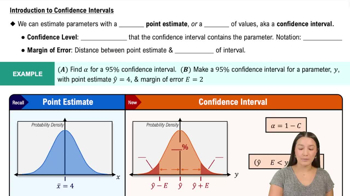
A confidence interval is a range of values, derived from sample statistics, that is likely to contain the true population parameter. It is expressed as an interval estimate, typically calculated as the sample proportion plus or minus the margin of error. For example, if 57% of respondents reported a positive experience, and the margin of error is ±3.6%, the confidence interval would be from 53.4% to 60.6%.
추천 영상:
06:33
Introduction to Confidence Intervals

Margin of Error

The margin of error quantifies the uncertainty associated with a sample estimate. It indicates the range within which the true population parameter is expected to fall, based on the sample data. In this case, a margin of error of ±3.6% means that the true percentage of U.S. adults with a positive experience could be 3.6% higher or lower than the reported 57%.
추천 영상:
04:08
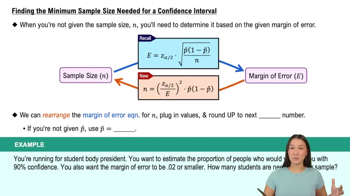
Finding the Minimum Sample Size Needed for a Confidence Interval

Level of Confidence

The level of confidence reflects the degree of certainty that the confidence interval contains the true population parameter. Common levels of confidence are 90%, 95%, and 99%, with higher levels indicating greater certainty but wider intervals. The level of confidence can be approximated based on the sample size and the margin of error, often using standard normal distribution values.
추천 영상:
06:33
Introduction to Confidence Intervals