Ch. 6 - Confidence Intervals
Larson - Elementary Statistics: Picturing the World 8th Edition
Larson8th EditionElementary Statistics: Picturing the WorldISBN: 9780137493470당신이 사용하는 게 아니라요?교과서 변경
6장, 문제 6.R.25b

You wish to estimate, with 95% confidence, the population proportion of U.S. adults who have taken or planned to take a winter vacation in a recent year. Your estimate must be accurate within 5% of the population proportion.
b. Find the minimum sample size needed, using a prior study that found that 32% of U.S. adults have taken or planned to take a winter vacation in a recent year. (Source: Rasmussen Reports)

검증된 단계별 안내
1
Step 1: Identify the formula for determining the minimum sample size for estimating a population proportion. The formula is: n = (Z^2 * p * (1 - p)) / E^2, where n is the sample size, Z is the z-score corresponding to the desired confidence level, p is the estimated population proportion, and E is the margin of error.
Step 2: Determine the values for the variables in the formula. For a 95% confidence level, the z-score (Z) is approximately 1.96. The estimated population proportion (p) is 0.32, and the margin of error (E) is 0.05.
Step 3: Substitute the values into the formula. This gives: n = (1.96^2 * 0.32 * (1 - 0.32)) / 0.05^2.
Step 4: Simplify the expression step by step. First, calculate 1.96^2, then multiply it by 0.32 and (1 - 0.32), and finally divide by 0.05^2.
Step 5: Round the result up to the nearest whole number, as the sample size must be a whole number. This will give you the minimum sample size needed to estimate the population proportion with the specified accuracy and confidence level.

비슷한 문제에 대한 검증된 영상 답변:

이 영상 해법은 위 문제에 도움이 된다고 튜터들이 추천한 것입니다.
영상 길이:
2m
도움이 되었나요?

주요 개념

질문에 올바르게 답하기 위해 반드시 이해해야 하는 핵심 개념들은 다음과 같습니다.

Confidence Interval

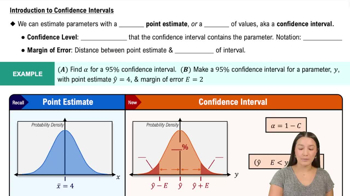
A confidence interval is a range of values, derived from sample statistics, that is likely to contain the true population parameter. In this case, a 95% confidence interval means that if we were to take many samples and build intervals, approximately 95% of those intervals would contain the true proportion of U.S. adults who have taken or planned a winter vacation.
추천 영상:
가이드 코스
06:33
Introduction to Confidence Intervals

Sample Size Calculation

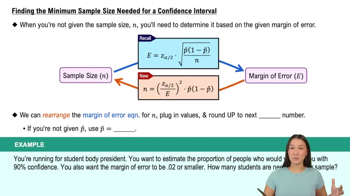
Sample size calculation is a statistical method used to determine the number of observations or replicates needed to achieve a desired level of precision in estimating a population parameter. For estimating proportions, the formula incorporates the desired confidence level, the estimated proportion from prior studies, and the margin of error, which in this case is set at 5%.
추천 영상:
가이드 코스
05:11
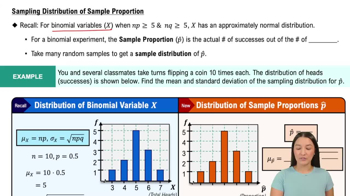
Sampling Distribution of Sample Proportion

Margin of Error

The margin of error is the range within which the true population parameter is expected to fall, given a certain level of confidence. It reflects the precision of the estimate; a smaller margin of error indicates a more precise estimate. In this scenario, a 5% margin of error means the estimate of the population proportion can vary by 5 percentage points above or below the calculated proportion.
추천 영상:
가이드 코스
04:08
Finding the Minimum Sample Size Needed for a Confidence Interval