Ch. 7 - Hypothesis Testing with One Sample
Larson - Elementary Statistics: Picturing the World 8th Edition
Larson8th EditionElementary Statistics: Picturing the WorldISBN: 9780137493470당신이 사용하는 게 아니라요?교과서 변경
7장, 문제 7.2.28

Finding Critical Values and Rejection Regions In Exercises 23–28, find the critical value(s) and rejection region(s) for the type of z-test with level of significance α. Include a graph with your answer.


Two-tailed test, α = 0.12

검증된 단계별 안내
1
Step 1: Understand the problem. This is a two-tailed z-test with a significance level (α) of 0.12. In a two-tailed test, the rejection regions are located in both tails of the standard normal distribution, and the total area of the rejection regions equals α.
Step 2: Divide the significance level (α) equally between the two tails. Since α = 0.12, each tail will have an area of α/2 = 0.12/2 = 0.06.
Step 3: Use the standard normal distribution table (z-table) or a statistical calculator to find the z-scores that correspond to the cumulative probabilities of 0.06 (left tail) and 1 - 0.06 = 0.94 (right tail). These z-scores are the critical values.
Step 4: Define the rejection regions. The rejection regions are the areas in the tails of the distribution where the test statistic falls outside the critical values. For a two-tailed test, the rejection regions are z < -z_critical (left tail) and z > z_critical (right tail).
Step 5: Visualize the result. Draw a standard normal distribution curve, mark the critical values on the z-axis, and shade the rejection regions in both tails. This graph helps to clearly illustrate the critical values and rejection regions.

비슷한 문제에 대한 검증된 영상 답변:

이 영상 해법은 위 문제에 도움이 된다고 튜터들이 추천한 것입니다.
영상 길이:
2m
도움이 되었나요?

주요 개념

질문에 올바르게 답하기 위해 반드시 이해해야 하는 핵심 개념들은 다음과 같습니다.

Critical Value

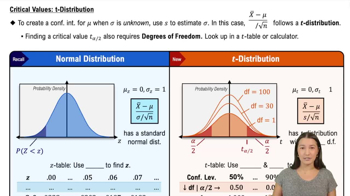
A critical value is a point on the scale of the test statistic that separates the region where the null hypothesis is rejected from the region where it is not rejected. In hypothesis testing, critical values are determined based on the significance level (α) and the type of test (one-tailed or two-tailed). For a two-tailed test, critical values are found at both extremes of the distribution.
추천 영상:
05:50
Critical Values: t-Distribution

Rejection Region

The rejection region is the range of values for the test statistic that leads to the rejection of the null hypothesis. In a two-tailed test, this region is divided into two parts, corresponding to the critical values on either side of the distribution. The size of the rejection region is determined by the significance level (α), which indicates the probability of making a Type I error.
추천 영상:
가이드 코스
09:56
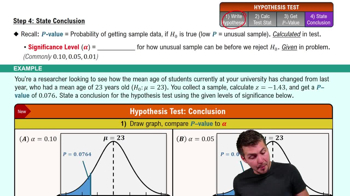
Step 4: State Conclusion

Two-Tailed Test

A two-tailed test is a statistical test that evaluates whether a sample mean is significantly different from a population mean in either direction (greater than or less than). This type of test is used when the alternative hypothesis does not specify a direction of the effect. For a significance level of α = 0.12, the critical values will be located at the 6% and 94% percentiles of the standard normal distribution.
추천 영상:
가이드 코스
09:27
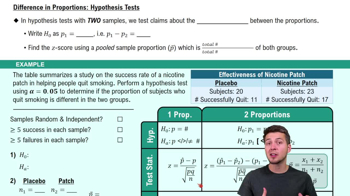
Difference in Proportions: Hypothesis Tests