Ch. 7 - Hypothesis Testing with One Sample
Larson - Elementary Statistics: Picturing the World 8th Edition
Larson8th EditionElementary Statistics: Picturing the WorldISBN: 9780137493470당신이 사용하는 게 아니라요?교과서 변경
7장, 문제 7.1.22

Identifying a Test In Exercises 21–24, determine whether the hypothesis test is left-tailed, right-tailed, or two-tailed.


Ha: μ ≥ 5.2
H0: μ < 5.2

검증된 단계별 안내
1
Step 1: Understand the null hypothesis (H0) and the alternative hypothesis (Ha). In this case, H0: μ < 5.2 and Ha: μ ≥ 5.2.
Step 2: Recall that the direction of the test is determined by the alternative hypothesis (Ha). Specifically, the inequality in Ha indicates the type of test.
Step 3: Note that Ha: μ ≥ 5.2 includes the 'greater than or equal to' condition. This suggests that we are testing whether the mean (μ) is greater than or equal to 5.2.
Step 4: Since the focus is on testing whether μ is greater than a specific value (5.2), this is a right-tailed test. A right-tailed test is used when the alternative hypothesis involves a 'greater than' condition.
Step 5: Conclude that the hypothesis test is right-tailed based on the direction of the inequality in the alternative hypothesis (Ha).

비슷한 문제에 대한 검증된 영상 답변:

이 영상 해법은 위 문제에 도움이 된다고 튜터들이 추천한 것입니다.
영상 길이:
1m
도움이 되었나요?

주요 개념

질문에 올바르게 답하기 위해 반드시 이해해야 하는 핵심 개념들은 다음과 같습니다.

Hypothesis Testing

Hypothesis testing is a statistical method used to make decisions about a population based on sample data. It involves formulating two competing hypotheses: the null hypothesis (H0), which represents a statement of no effect or no difference, and the alternative hypothesis (Ha), which represents what we aim to support. The outcome of the test helps determine whether to reject the null hypothesis in favor of the alternative.
추천 영상:
가이드 코스
06:21
Step 1: Write Hypotheses

One-Tailed vs. Two-Tailed Tests

In hypothesis testing, a one-tailed test evaluates the direction of the effect, either testing for an increase or a decrease, while a two-tailed test assesses for any significant difference in either direction. A left-tailed test looks for evidence that the parameter is less than a certain value, whereas a right-tailed test looks for evidence that it is greater. The choice between these tests depends on the research question and the hypotheses formulated.
추천 영상:
가이드 코스
09:27
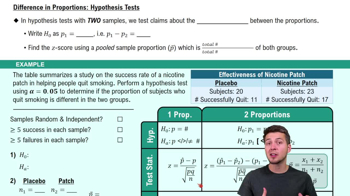
Difference in Proportions: Hypothesis Tests

Interpreting Hypotheses

Interpreting the null and alternative hypotheses is crucial for determining the type of test to conduct. In the given example, the null hypothesis (H0: μ < 5.2) suggests that the mean is less than 5.2, while the alternative hypothesis (Ha: μ ≥ 5.2) indicates that the mean is greater than or equal to 5.2. This setup implies a right-tailed test, as we are interested in whether the mean is significantly greater than 5.2.
추천 영상:
가이드 코스
06:21
Step 1: Write Hypotheses