Ch. 7 - Hypothesis Testing with One Sample
Larson - Elementary Statistics: Picturing the World 8th Edition
Larson8th EditionElementary Statistics: Picturing the WorldISBN: 9780137493470당신이 사용하는 게 아니라요?교과서 변경
7장, 문제 7.RE.9e

In Exercises 7–10, explain how you should interpret a decision that fails to reject the null hypothesis.


A nonprofit consumer organization says that the standard deviation of the starting prices of its top-rated vehicles for a recent year is no more than \$2900.

검증된 단계별 안내
1
Step 1: Understand the null hypothesis (H₀) and alternative hypothesis (H₁). In this case, the null hypothesis (H₀) states that the standard deviation of the starting prices of the top-rated vehicles is no more than \(2900 (σ ≤ 2900). The alternative hypothesis (H₁) would state that the standard deviation is greater than \)2900 (σ > 2900).
Step 2: Recognize the meaning of 'failing to reject the null hypothesis.' Failing to reject H₀ means that the sample data does not provide sufficient evidence to conclude that the standard deviation is greater than \$2900. It does not confirm that H₀ is true; it simply indicates that there is not enough statistical evidence to support H₁.
Step 3: Consider the implications of the decision. Failing to reject H₀ suggests that the claim made by the nonprofit consumer organization (that the standard deviation is no more than \$2900) is consistent with the sample data. However, this does not guarantee that the true standard deviation is exactly \$2900 or less—it only means the data does not strongly contradict this claim.
Step 4: Reflect on the role of significance level (α). The decision to fail to reject H₀ is based on the chosen significance level (e.g., α = 0.05). If the p-value from the test is greater than α, we fail to reject H₀. This threshold helps control the probability of making a Type I error (rejecting a true null hypothesis).
Step 5: Acknowledge the limitations of the test. Statistical tests are based on sample data, and failing to reject H₀ does not imply certainty about the population parameter. It is important to consider the sample size, variability, and other factors that might affect the reliability of the conclusion.

비슷한 문제에 대한 검증된 영상 답변:

이 영상 해법은 위 문제에 도움이 된다고 튜터들이 추천한 것입니다.
영상 길이:
3m
도움이 되었나요?

주요 개념

질문에 올바르게 답하기 위해 반드시 이해해야 하는 핵심 개념들은 다음과 같습니다.

Null Hypothesis

The null hypothesis is a statement that there is no effect or no difference, and it serves as the default assumption in statistical testing. In this context, it posits that the standard deviation of the starting prices of the vehicles is $2900 or less. Failing to reject the null hypothesis means that there is not enough evidence to support a claim that the standard deviation exceeds this value.
추천 영상:
가이드 코스
06:21
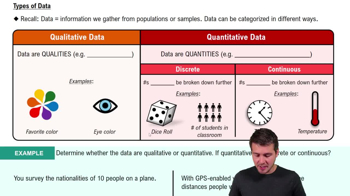
Step 1: Write Hypotheses

Statistical Significance

Statistical significance refers to the likelihood that a result or relationship is caused by something other than mere chance. In hypothesis testing, a result is considered statistically significant if the p-value is less than a predetermined threshold (commonly 0.05). When a decision fails to reject the null hypothesis, it suggests that the evidence is not strong enough to conclude that the standard deviation is greater than $2900.
추천 영상:
가이드 코스
05:53
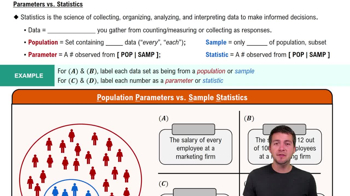
Parameters vs. Statistics

Type II Error

A Type II error occurs when a statistical test fails to reject a false null hypothesis, meaning that a real effect or difference is overlooked. In the context of the nonprofit organization, if the true standard deviation of starting prices is indeed greater than $2900, but the test fails to reject the null hypothesis, a Type II error has occurred. This highlights the importance of sample size and power in hypothesis testing to minimize such errors.
추천 영상: