
Ch. 7 - Hypothesis Testing with One Sample
Larson - Elementary Statistics: Picturing the World 8th Edition
Larson8th EditionElementary Statistics: Picturing the WorldISBN: 9780137493470당신이 사용하는 게 아니라요?교과서 변경
7장, 문제 7.R.2

n Exercises 1–6, the statement represents a claim. Write its complement and state which is H0 and which is Ha.


μ = 82

검증된 단계별 안내
1
Step 1: Understand the problem. The given claim is μ = 82, where μ represents the population mean. This is a statement about the population parameter.
Step 2: Write the complement of the claim. The complement of μ = 82 is μ ≠ 82, as the complement represents all values of μ that are not equal to 82.
Step 3: Identify the null hypothesis (H0). The null hypothesis is the statement of equality, so H0: μ = 82.
Step 4: Identify the alternative hypothesis (Ha). The alternative hypothesis is the complement of the null hypothesis, so Ha: μ ≠ 82.
Step 5: Summarize the hypotheses. H0: μ = 82 (null hypothesis), Ha: μ ≠ 82 (alternative hypothesis). These hypotheses will be used in hypothesis testing to determine if there is enough evidence to reject H0 in favor of Ha.

비슷한 문제에 대한 검증된 영상 답변:

이 영상 해법은 위 문제에 도움이 된다고 튜터들이 추천한 것입니다.
영상 길이:
2m
도움이 되었나요?

주요 개념

질문에 올바르게 답하기 위해 반드시 이해해야 하는 핵심 개념들은 다음과 같습니다.

Null Hypothesis (H0)

The null hypothesis (H0) is a statement that indicates no effect or no difference, serving as a default position in statistical testing. In this case, H0 states that the population mean (μ) is equal to 82. It is the hypothesis that researchers aim to test against, and it is assumed true until evidence suggests otherwise.
추천 영상:
가이드 코스
06:21
Step 1: Write Hypotheses

Alternative Hypothesis (Ha)

The alternative hypothesis (Ha) represents a statement that contradicts the null hypothesis, suggesting that there is an effect or a difference. For the given claim, Ha would state that the population mean (μ) is not equal to 82. This hypothesis is what researchers seek to support through statistical evidence.
추천 영상:
가이드 코스
06:21
Step 1: Write Hypotheses

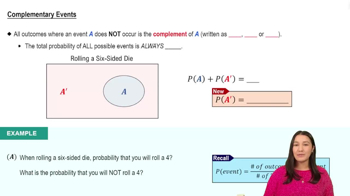
Complement of a Hypothesis

The complement of a hypothesis refers to the opposite scenario of the original claim. In this context, if the claim is μ = 82, the complement would be μ ≠ 82. Understanding the complement is crucial for hypothesis testing, as it helps define the scope of the alternative hypothesis and the potential outcomes of the statistical test.
추천 영상:
4:23
Complementary Events
관련 실천
교과서 질문

A hat company claims that the mean hat size for a male is at least 7.25. A random sample of 12 hat sizes has a mean of 7.15. At α=0.01, can you reject the company’s claim? Assume the population is normally distributed and the population standard deviation is 0.27.

56
views
교과서 질문

n Exercises 1–6, the statement represents a claim. Write its complement and state which is H0 and which is Ha.


μ ≠ 150,020

92
views
교과서 질문

A nonprofit consumer organization says that less than 25% of the televisions the organization rated in a recent year have an overall score of 70 or more. In a random sample of 35 televisions the organization rated in a recent year, 23% have an overall score of 70 or more. At α=0.05, can you support the organization’s claim?

43
views
교과서 질문

In Exercises 7–10, (a) state the null and alternative hypotheses and identify which represents the claim.

A nonprofit consumer organization says that the standard deviation of the starting prices of its top-rated vehicles for a recent year is no more than \$2900.

60
views
교과서 질문

n Exercises 1–6, the statement represents a claim. Write its complement and state which is H0 and which is Ha.


p ≥ 0.64

93
views
교과서 질문

In Exercises 7–10, explain whether the hypothesis test is left-tailed, right-tailed, or two-tailed. A nonprofit consumer organization says that the standard deviation of the starting prices of its top-rated vehicles for a recent year is no more than \$2900.

77
views