Ch. 7 - Hypothesis Testing with One Sample
Larson - Elementary Statistics: Picturing the World 8th Edition
Larson8th EditionElementary Statistics: Picturing the WorldISBN: 9780137493470당신이 사용하는 게 아니라요?교과서 변경
7장, 문제 7.1.56

Writing A null hypothesis is rejected with a level of significance of 0.10. Is it also rejected at a level of significance of 0.05? Explain.

검증된 단계별 안내
1
Understand the concept of the level of significance: The level of significance (denoted as α) is the probability of rejecting the null hypothesis when it is actually true. A smaller α represents a stricter criterion for rejecting the null hypothesis.
Recognize the relationship between α = 0.10 and α = 0.05: A level of significance of 0.05 is more stringent than 0.10. This means that if a null hypothesis is rejected at α = 0.10, it does not necessarily mean it will be rejected at α = 0.05.
Recall the p-value approach: The p-value is the probability of observing the test statistic or something more extreme under the null hypothesis. If the p-value is less than or equal to the level of significance, the null hypothesis is rejected.
Compare the p-value to both levels of significance: If the p-value is less than or equal to 0.10 but greater than 0.05, the null hypothesis will be rejected at α = 0.10 but not at α = 0.05. If the p-value is less than or equal to 0.05, the null hypothesis will be rejected at both levels of significance.
Conclude based on the p-value: To determine whether the null hypothesis is rejected at α = 0.05, you need to know the p-value. If the p-value is not provided, you cannot definitively conclude whether the null hypothesis is rejected at the stricter level of significance.

비슷한 문제에 대한 검증된 영상 답변:

이 영상 해법은 위 문제에 도움이 된다고 튜터들이 추천한 것입니다.
영상 길이:
1m
도움이 되었나요?

주요 개념

질문에 올바르게 답하기 위해 반드시 이해해야 하는 핵심 개념들은 다음과 같습니다.

Null Hypothesis

The null hypothesis is a statement that there is no effect or no difference, and it serves as the default assumption in hypothesis testing. Researchers aim to gather evidence to either reject or fail to reject this hypothesis based on sample data. In this context, rejecting the null hypothesis at a significance level indicates that the observed data is unlikely under the assumption that the null hypothesis is true.
추천 영상:
가이드 코스
06:21
Step 1: Write Hypotheses

Level of Significance

The level of significance, often denoted as alpha (α), is the threshold for determining whether to reject the null hypothesis. It represents the probability of making a Type I error, which occurs when the null hypothesis is incorrectly rejected. Common levels of significance are 0.05 and 0.10, with lower values indicating stricter criteria for rejecting the null hypothesis.
추천 영상:
03:33
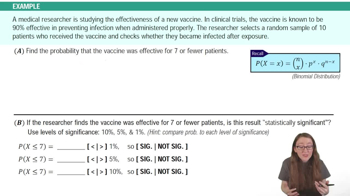
Finding Binomial Probabilities Using TI-84 Example 1

P-Value

The p-value is a statistical measure that helps determine the strength of the evidence against the null hypothesis. It quantifies the probability of observing the sample data, or something more extreme, if the null hypothesis is true. If the p-value is less than the chosen level of significance, the null hypothesis is rejected. Therefore, if a null hypothesis is rejected at 0.10, it may or may not be rejected at 0.05, depending on the p-value.
추천 영상:
가이드 코스
06:50
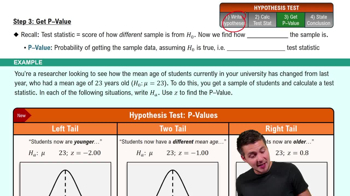
Step 3: Get P-Value