Ch. 7 - Hypothesis Testing with One Sample
Larson - Elementary Statistics: Picturing the World 8th Edition
Larson8th EditionElementary Statistics: Picturing the WorldISBN: 9780137493470당신이 사용하는 게 아니라요?교과서 변경
7장, 문제 7.2.46

Writing In a right-tailed test where P < alpha, does the standardized test statistic lie to the left or the right of the critical value? Explain your reasoning.

검증된 단계별 안내
1
Understand the context of the problem: A right-tailed test is a hypothesis test where the rejection region is located in the right tail of the distribution. This means we are testing whether the test statistic is significantly greater than the critical value.
Recall the relationship between P-value and alpha: If P < alpha, it indicates that the observed data is statistically significant, and we reject the null hypothesis.
Understand the role of the critical value: The critical value is the threshold that separates the rejection region (right tail) from the non-rejection region. In a right-tailed test, any test statistic greater than the critical value falls in the rejection region.
Analyze the placement of the standardized test statistic: Since P < alpha, the test statistic must fall in the rejection region. In a right-tailed test, this means the test statistic lies to the right of the critical value.
Summarize the reasoning: The standardized test statistic lies to the right of the critical value because the P-value being less than alpha indicates that the test statistic is in the rejection region, which is located in the right tail of the distribution.

비슷한 문제에 대한 검증된 영상 답변:

이 영상 해법은 위 문제에 도움이 된다고 튜터들이 추천한 것입니다.
영상 길이:
2m
도움이 되었나요?

주요 개념

질문에 올바르게 답하기 위해 반드시 이해해야 하는 핵심 개념들은 다음과 같습니다.

Right-tailed Test

A right-tailed test is a type of hypothesis test where the critical region for rejecting the null hypothesis is located in the right tail of the distribution. This means that we are looking for evidence that the sample statistic is significantly greater than the hypothesized parameter. In this context, if the p-value is less than the significance level (alpha), it indicates strong evidence against the null hypothesis.
추천 영상:
가이드 코스
06:34
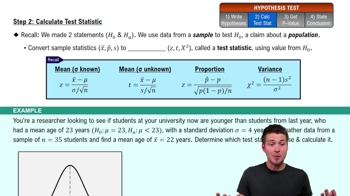
Step 2: Calculate Test Statistic

Critical Value

The critical value is a threshold that determines the boundary for rejecting the null hypothesis in a statistical test. In a right-tailed test, the critical value is located at the alpha level on the right side of the distribution. If the standardized test statistic exceeds this critical value, it suggests that the observed data is statistically significant, leading to the rejection of the null hypothesis.
추천 영상:
05:50
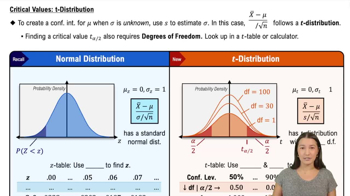
Critical Values: t-Distribution

Standardized Test Statistic

The standardized test statistic is a value that indicates how many standard deviations an observed value is from the mean under the null hypothesis. In a right-tailed test, if the standardized test statistic is greater than the critical value, it suggests that the observed data is significantly higher than expected. Therefore, when P < alpha, the standardized test statistic lies to the right of the critical value, indicating statistical significance.
추천 영상:
가이드 코스
06:34
Step 2: Calculate Test Statistic
관련 실천
교과서 질문

Explain the difference between the z-test for μ using a P-value and the z-test for μ using rejection region(s).

109
views

교과서 질문

Does failing to reject the null hypothesis mean that the null hypothesis is true? Explain.

397
views
교과서 질문

Explain how to use a t-test to test a hypothesized mean mu when sigma is unknown. What assumptions are necessary?

125
views
교과서 질문

In Exercises 3–8, find the critical value(s) and rejection region(s) for the type of t-test with level of significance alpha and sample size n.


Right-tailed test, α=0.01, n=31

97
views
교과서 질문

Dive Duration An oceanographer claims that the mean dive duration of a North Atlantic right whale is 11.5 minutes. A random sample of 34 dive durations has a mean of 12.2 minutes and a standard deviation of 2.2 minutes. Is there enough evidence to reject the claim at α=0.10?

65
views
교과서 질문

Hypothesis Testing Using Rejection Regions In Exercises 7–12, (a) identify the claim and state H0 and Ha, (b) find the critical value(s) and identify the rejection region(s), (c) find the standardized test statistic z, (d) decide whether to reject or fail to reject the null hypothesis, and (e) interpret the decision in the context of the original claim.


Working Students An education researcher claims that 65% of full-time college students work year-round. In a random sample of 105 college students, 66 say they work year-round. At α=0.10, is there enough evidence to reject the researcher’s claim?

130
views