
Ch. 1 - Introduction to Statistics
Triola - Elementary Statistics 14th Edition
Triola14th EditionElementary StatisticsISBN: 9780137366446당신이 사용하는 게 아니라요?교과서 변경
1장, 문제 1.1.15

In Exercises 13–20, determine whether the results appear to have statistical significance, and also determine whether the results appear to have practical significance.


Mendel’s Genetics Experiments One of Gregor Mendel’s famous hybridization experiments with peas yielded 580 offspring with 152 of those peas (or 26%) having yellow pods. According to Mendel’s theory, 25% of the offspring peas should have yellow pods.

검증된 단계별 안내
1
Step 1: Define the null hypothesis (H0) and the alternative hypothesis (H1). The null hypothesis is that the proportion of peas with yellow pods is 25% (p = 0.25), as predicted by Mendel's theory. The alternative hypothesis is that the proportion is different from 25% (p ≠ 0.25).
Step 2: Calculate the sample proportion (p̂) of peas with yellow pods. This is done by dividing the number of peas with yellow pods (152) by the total number of peas (580).
Step 3: Determine the standard error of the sample proportion. The standard error (SE) is calculated using the formula: SE = sqrt((p * (1 - p)) / n), where p is the hypothesized population proportion (0.25) and n is the sample size (580).
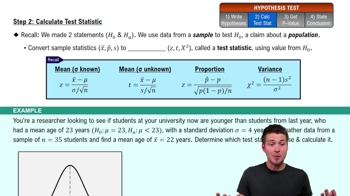
Step 4: Calculate the test statistic (z-score) using the formula: z = (p̂ - p) / SE, where p̂ is the sample proportion, p is the hypothesized population proportion, and SE is the standard error calculated in the previous step.
Step 5: Compare the calculated z-score to the critical z-value for a chosen significance level (commonly 0.05 for a two-tailed test). If the absolute value of the z-score is greater than the critical z-value, the null hypothesis is rejected, indicating statistical significance. Additionally, consider whether the difference between the observed and expected proportions is large enough to be of practical significance.

비슷한 문제에 대한 검증된 영상 답변:

이 영상 해법은 위 문제에 도움이 된다고 튜터들이 추천한 것입니다.
영상 길이:
2m
도움이 되었나요?

주요 개념

질문에 올바르게 답하기 위해 반드시 이해해야 하는 핵심 개념들은 다음과 같습니다.

Statistical Significance

Statistical significance refers to the likelihood that a result or relationship is caused by something other than mere random chance. In the context of Mendel's experiment, it involves determining whether the observed 26% of yellow pods significantly deviates from the expected 25% under Mendel's theory, using a hypothesis test and a significance level (e.g., 0.05).
추천 영상:
가이드 코스
06:34
Step 2: Calculate Test Statistic

Practical Significance

Practical significance considers whether the size of the effect or difference is large enough to be meaningful in a real-world context. Even if the 1% difference in Mendel's experiment is statistically significant, it may not be practically significant if it doesn't have a substantial impact on the understanding or application of genetic principles.
추천 영상:
가이드 코스
04:46
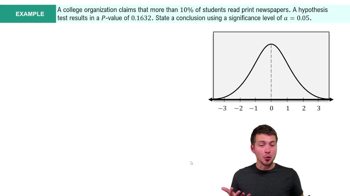
Step 4: State Conclusion Example 4

Hypothesis Testing

Hypothesis testing is a statistical method used to decide whether there is enough evidence to reject a null hypothesis. In Mendel's experiment, the null hypothesis might state that the proportion of yellow pods is 25%, and a test (e.g., chi-square test) would determine if the observed 26% provides sufficient evidence to reject this hypothesis.
추천 영상:
가이드 코스
06:21
Step 1: Write Hypotheses
관련 실천
교과서 질문

In Exercises 9–20, identify which of these types of sampling is used: random, systematic, convenience, stratified, or cluster.

Reported and Observed Results A Harris Interactive study involved 1013 adults who were interviewed about washing their hands in restrooms and another 6336 adults who were observed in public restrooms.

339
views
교과서 질문

In Exercises 21–28, determine which of the four levels of measurement (nominal, ordinal, interval, ratio) best describes the given data.

Movie Ratings In a college film studies course, students rate ten documentaries using a scale of 0 to 5 stars.

317
views
교과서 질문

In Exercises 37–44, answer the given questions, which are related to percentages.

Checking Job Applicants In a study conducted by the Society for Human Resource Management, 347 human resource professionals were surveyed. Of those surveyed, 73% said that their companies conduct criminal background checks on all job applicants.


a. What is the exact value that is 73% of the 347 survey subjects?

b. Could the result from part (a) be the actual number of survey subjects who said that their companies conduct criminal background checks on all job applicants? Why or why not?

388
views
교과서 질문

Quantitative/Categorical Data Identify each of the following as quantitative data or categorical data


c. The colors of the M&M candies in Data Set 38 “Candies” in Appendix B

206
views
교과서 질문

In Exercises 29–36, identify what is wrong.

Storks and Babies In the years following the end of World War II, it was found that there was a strong correlation, or association, between the number of human births and the stork population. It therefore follows that storks cause babies.

292
views
교과서 질문

Sampling Method The patients were recruited among those at a Veterans Affairs hospital. What type of sampling best describes the way in which the subjects were chosen: simple random sample, systematic sample, convenience sample, stratified sample, cluster sample? Does the method of sampling appear to adversely affect the quality of the results?

282
views