

Ch. 3 - Describing, Exploring, and Comparing Data
Triola - Elementary Statistics 14th Edition
Triola14th EditionElementary StatisticsISBN: 9780137366446당신이 사용하는 게 아니라요?교과서 변경
3장, 문제 3.3.5b

z Scores. In Exercises 5–8, express all z scores with two decimal places.


Diastolic Blood Pressure of Females For the diastolic blood pressure measurements of females listed in Data Set 1 “Body Data” in Appendix B, the highest measurement is 98 mm Hg. The 147 diastolic blood pressure measurements of females have a mean of 70.2 mm Hg and a standard deviation of 11.2 mm Hg.


b. How many standard deviations is that [the difference found in part (a)]?

검증된 단계별 안내
1
Step 1: Recall the formula for calculating a z-score: z = (X - μ) / σ, where X is the value of interest, μ is the mean, and σ is the standard deviation.
Step 2: Identify the given values from the problem: X = 98 mm Hg (the highest measurement), μ = 70.2 mm Hg (the mean), and σ = 11.2 mm Hg (the standard deviation).
Step 3: Substitute the given values into the z-score formula. This will look like: z = (98 - 70.2) / 11.2.
Step 4: Simplify the numerator by subtracting the mean (70.2) from the value of interest (98). This gives the difference, which represents how far the value is from the mean.
Step 5: Divide the difference obtained in Step 4 by the standard deviation (11.2) to calculate the z-score, which represents how many standard deviations the value is from the mean.

비슷한 문제에 대한 검증된 영상 답변:

이 영상 해법은 위 문제에 도움이 된다고 튜터들이 추천한 것입니다.
영상 길이:
1m
도움이 되었나요?

주요 개념

질문에 올바르게 답하기 위해 반드시 이해해야 하는 핵심 개념들은 다음과 같습니다.

Z-Scores

A z-score is a statistical measurement that describes a value's relationship to the mean of a group of values. It is calculated by subtracting the mean from the value and then dividing by the standard deviation. This standardization allows for comparison across different datasets by indicating how many standard deviations a data point is from the mean.
추천 영상:
가이드 코스
06:31
Z-Scores From Given Probability - TI-84 (CE) Calculator

Mean

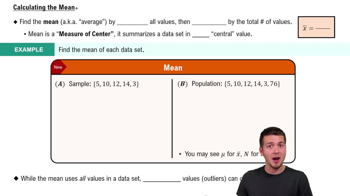
The mean, or average, is a measure of central tendency that is calculated by summing all values in a dataset and dividing by the number of values. In the context of the diastolic blood pressure measurements, the mean provides a reference point to understand the typical blood pressure level among the sampled females, which is essential for calculating z-scores.
추천 영상:
가이드 코스
04:52
Calculating the Mean

Standard Deviation

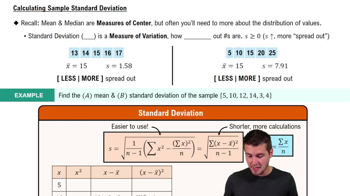
Standard deviation is a statistic that quantifies the amount of variation or dispersion in a set of values. A low standard deviation indicates that the values tend to be close to the mean, while a high standard deviation indicates that the values are spread out over a wider range. In this question, the standard deviation is crucial for determining how far a specific measurement is from the mean in terms of standard deviations.
추천 영상:
가이드 코스
08:45
Calculating Standard Deviation
관련 실천
교과서 질문

z Scores. In Exercises 5–8, express all z scores with two decimal places.


Diastolic Blood Pressure of Females For the diastolic blood pressure measurements of females listed in Data Set 1 “Body Data” in Appendix B, the highest measurement is 98 mm Hg. The 147 diastolic blood pressure measurements of females have a mean of 70.2 mm Hg and a standard deviation of 11.2 mm Hg.


c. Convert the highest diastolic blood pressure to a z score.

140
views
교과서 질문

z Scores. In Exercises 5–8, express all z scores with two decimal places.


New York City Commute Time New York City commute times (minutes) are listed in Data Set 31 “Commute Times” in Appendix B. The 1000 times have a mean of 42.6 minutes and a standard deviation of 26.2 minutes. Consider the commute time of 95.0 minutes.


c. Convert the commute time of 95.0 minutes to a z score.

127
views
교과서 질문

Degrees of Freedom Five recent U.S. presidents had a mean age of 56.2 years at the time of their inauguration. Four of these ages are 64, 46, 54, and 47.


a. Find the missing value.

107
views
교과서 질문

z Scores. In Exercises 5–8, express all z scores with two decimal places.


New York City Commute Time New York City commute times (minutes) are listed in Data Set 31 “Commute Times” in Appendix B. The 1000 times have a mean of 42.6 minutes and a standard deviation of 26.2 minutes. Consider the commute time of 95.0 minutes.


b. How many standard deviations is that [the difference found in part (a)]?

104
views
교과서 질문

z Scores. In Exercises 5–8, express all z scores with two decimal places.


Diastolic Blood Pressure of Females For the diastolic blood pressure measurements of females listed in Data Set 1 “Body Data” in Appendix B, the highest measurement is 98 mm Hg. The 147 diastolic blood pressure measurements of females have a mean of 70.2 mm Hg and a standard deviation of 11.2 mm Hg.


a. What is the difference between the highest diastolic blood pressure and the mean of the diastolic blood pressures for females?

143
views
교과서 질문

Why Divide by ? Let a population consist of the values 9 cigarettes, 10 cigarettes, and 20 cigarettes smoked in a day (based on data from the California Health Interview Survey). Assume that samples of two values are randomly selected with replacement from this population. (That is, a selected value is replaced before the second selection is made.)

b. After listing the nine different possible samples of two values selected with replacement, find the sample variance (which includes division by ) for each of them; then find the mean of the nine sample variances s2.

155
views