Ch. 4 - Probability
Triola - Elementary Statistics 14th Edition
Triola14th EditionElementary StatisticsISBN: 9780137366446당신이 사용하는 게 아니라요?교과서 변경
4장, 문제 4.4.38b

High Fives


b. If n mathletes shake hands with each other exactly once, what is the total number of handshakes?

검증된 단계별 안내
1
Understand the problem: The goal is to calculate the total number of handshakes if n mathletes each shake hands with every other mathlete exactly once. This is a combinatorics problem where we need to count the number of unique pairs that can be formed from n individuals.
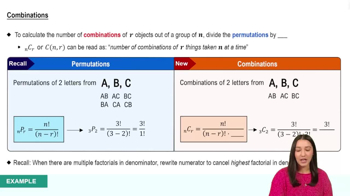
Recall the formula for combinations: The number of ways to choose 2 individuals from a group of n is given by the combination formula: n!r!(n-r)!, where n is the total number of individuals, r is the size of the group being chosen (in this case, 2), and ! denotes factorial.
Simplify the formula for this specific case: Since r = 2, the formula becomes n(n-1)2. This represents the total number of unique pairs (handshakes) that can be formed.
Substitute the value of n into the formula: Replace n with the given number of mathletes in the problem. For example, if there are 5 mathletes, substitute n = 5 into the formula.
Perform the calculation: Compute the value of n(n-1)2 to find the total number of handshakes. This will give you the final answer.

비슷한 문제에 대한 검증된 영상 답변:

이 영상 해법은 위 문제에 도움이 된다고 튜터들이 추천한 것입니다.
영상 길이:
2m
도움이 되었나요?

주요 개념

질문에 올바르게 답하기 위해 반드시 이해해야 하는 핵심 개념들은 다음과 같습니다.

Combinatorics

Combinatorics is a branch of mathematics dealing with combinations and arrangements of objects. In the context of the handshake problem, it helps determine how many unique pairs can be formed from a group of 'n' individuals. The formula used is based on combinations, specifically 'n choose 2', which calculates the number of ways to select 2 individuals from 'n' without regard to the order.

Combination Formula

The combination formula, denoted as C(n, k) = n! / (k!(n-k)!), is used to find the number of ways to choose 'k' elements from a set of 'n' elements. For the handshake problem, we set k to 2, as each handshake involves a pair of mathletes. This formula simplifies the calculation of handshakes by eliminating the need to list all possible pairs.
추천 영상:

Factorial

A factorial, denoted as n!, is the product of all positive integers up to 'n'. It is a fundamental concept in combinatorics, as it provides the basis for calculating combinations and permutations. In the handshake problem, factorials are used in the combination formula to compute the total number of unique handshakes among 'n' mathletes, ensuring accurate counting of pairs.
추천 영상:
관련 실천
교과서 질문

Alarm Clock Life Hack Each of us must sometimes wake up early for something really important, such as a final exam, job interview, or an early flight. (Professional golfer Jim Furyk was disqualified from a tournament when his cellphone lost power and he overslept.) Assume that a battery-powered alarm clock has a 0.005 probability of failure, a smartphone alarm clock has a 0.052 probability of failure, and an electric alarm clock has a 0.001 probability of failure.


b. If you use a battery-powered alarm clock and a smartphone alarm clock, what is the probability that they both fail? What is the probability that both of them do not fail?

211
views
교과서 질문

Denomination Effect

In Exercises 13–16, use the data in the following table. In an experiment to study the effects of using four quarters versus a \$1 bill, some college students were given four quarters and others were given a \(1 bill, and they could either keep the money or spend it on gum. The results are summarized in the table (based on data from “The Denomination Effect,” by Priya Raghubir and Joydeep Srivastava, Journal of Consumer Research, Vol. 36).


Denomination Effect


a. Find the probability of randomly selecting a student who spent the money, given that the student was given a \)1 bill.


159
views
교과서 질문

In Exercises 9–20, use the data in the following table, which lists survey results from high school drivers at least 16 years of age (based on data from “Texting While Driving and Other Risky Motor Vehicle Behaviors Among U.S. High School Students,” by O’Malley, Shults, and Eaton, Pediatrics, Vol. 131, No. 6). Assume that subjects are randomly selected from those included in the table. Hint: Be very careful to read the question correctly.

Texting While Driving If two of the high school drivers are randomly selected, find the probability that they both texted while driving.

a. Assume that the selections are made with replacement. Are the events independent?

156
views
교과서 질문

In Exercises 9–20, use the data in the following table, which lists survey results from high school drivers at least 16 years of age (based on data from “Texting While Driving and Other Risky Motor Vehicle Behaviors Among U.S. High School Students,” by O’Malley, Shults, and Eaton, Pediatrics, Vol. 131, No. 6). Assume that subjects are randomly selected from those included in the table. Hint: Be very careful to read the question correctly.

Drinking and Driving If two of the high school drivers are randomly selected, find the probability that they both drove when drinking alcohol.

b. Assume that the selections are made without replacement. Are the events independent?

125
views
교과서 질문

In Exercises 29 and 30, find the probabilities and indicate when the “5% guideline for cumbersome calculations” is used.


Medical Helicopters In a study of helicopter usage and patient survival, results were obtained from 47,637 patients transported by helicopter and 111,874 patients transported by ground (based on data from “Association Between Helicopter vs Ground Emergency Medical Services and Survival for Adults with Major Trauma,” by Galvagno et al., Journal of the American Medical Association, Vol. 307, No. 15).


b. If 5 of the subjects in the study are randomly selected without replacement, what is the probability that all of them were transported by helicopter?

242
views
교과서 질문

Mega Millions As of this writing, the Mega Millions lottery is run in 44 states. Winning the jackpot requires that you select the correct five different numbers from 1 to 70 and, in a separate drawing, you must also select the correct single number from 1 to 25.


a. Find the probability of winning the jackpot.

222
views