
Ch. 4 - Probability
Triola - Elementary Statistics 14th Edition
Triola14th EditionElementary StatisticsISBN: 9780137366446당신이 사용하는 게 아니라요?교과서 변경
4장, 문제 4.r.8

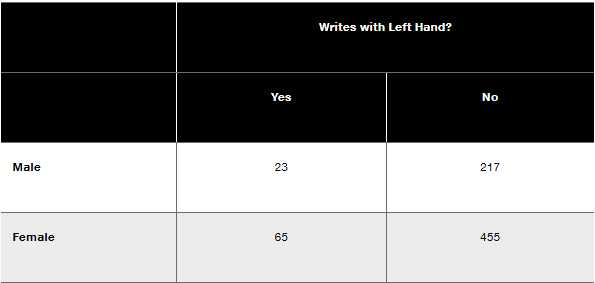
In Exercises 1–10, use the data in the accompanying table and express all results in decimal form. (The data are from “The Left-Handed: Their Sinister History,” by Elaine Fowler Costas, Education Resources Information Center, Paper 399519.)


"Table showing left-handedness: 23 left-handed males, 217 right-handed males, 65 left-handed females, 455 right-handed females."


Complement If L represents the event of randomly selecting one of the study subjects and getting someone who writes with their left hand, what does L represent? Find the value of P(L)

검증된 단계별 안내
1
Step 1: Understand the problem. The event L represents selecting a study subject who writes with their left hand. The complement of L, denoted as L', represents selecting a study subject who does NOT write with their left hand. We need to calculate P(L), the probability of event L occurring.
Step 2: Identify the total number of study subjects. Add all the values in the table: Total = (23 + 217) for males + (65 + 455) for females.
Step 3: Identify the number of subjects who write with their left hand. Add the values in the 'Yes' column: Left-handed total = 23 (males) + 65 (females).
Step 4: Calculate the probability of event L, P(L). Use the formula for probability: P(L) = (Number of left-handed subjects) / (Total number of subjects).
Step 5: Express the result in decimal form. Divide the left-handed total by the overall total and ensure the result is in decimal format.

비슷한 문제에 대한 검증된 영상 답변:

이 영상 해법은 위 문제에 도움이 된다고 튜터들이 추천한 것입니다.
영상 길이:
3m
도움이 되었나요?

주요 개념

질문에 올바르게 답하기 위해 반드시 이해해야 하는 핵심 개념들은 다음과 같습니다.

Probability

Probability is a measure of the likelihood that a particular event will occur, expressed as a number between 0 and 1. In this context, P(L) represents the probability of randomly selecting a subject who writes with their left hand. It is calculated by dividing the number of left-handed individuals by the total number of individuals in the study.
추천 영상:
5:37
Introduction to Probability

Complement of an Event

The complement of an event refers to all outcomes in a sample space that are not part of the event. For the event L (selecting a left-handed individual), the complement would be selecting a right-handed individual. Understanding complements is crucial for calculating probabilities and interpreting results in statistics.
추천 영상:
4:23
Complementary Events

Data Representation

Data representation involves organizing and displaying data in a way that makes it easy to analyze and interpret. In this case, the data is presented in a table format, showing the number of left-handed and right-handed individuals by gender. This structured format helps in calculating probabilities and understanding the distribution of left-handedness in the sample.
추천 영상:
가이드 코스
04:39
Visualizing Qualitative vs. Quantitative Data