Ch. 4 - Probability
Triola - Elementary Statistics 14th Edition
Triola14th EditionElementary StatisticsISBN: 9780137366446당신이 사용하는 게 아니라요?교과서 변경
4장, 문제 4.q.2

Standard Tests Standard tests, such as the SAT or ACT or MCAT, tend to make extensive use of multiple-choice questions because they are easy to grade using software. If one such multiple choice question has possible correct answers of a, b, c, d, e, what is the probability of a wrong answer if the answer is a random guess?

검증된 단계별 안내
1
Step 1: Understand the problem. The question asks for the probability of a wrong answer when a random guess is made on a multiple-choice question with 5 possible answers (a, b, c, d, e).
Step 2: Recall the formula for probability. The probability of an event occurring is given by the formula: P(Event) = (Number of favorable outcomes) / (Total number of possible outcomes).
Step 3: Identify the total number of possible outcomes. In this case, there are 5 possible answers (a, b, c, d, e), so the total number of possible outcomes is 5.
Step 4: Determine the number of favorable outcomes for a wrong answer. Since only one answer is correct, the number of wrong answers is 5 - 1 = 4.
Step 5: Calculate the probability of a wrong answer using the formula: P(Wrong Answer) = (Number of wrong answers) / (Total number of possible answers) = 4 / 5.

비슷한 문제에 대한 검증된 영상 답변:

이 영상 해법은 위 문제에 도움이 된다고 튜터들이 추천한 것입니다.
영상 길이:
2m
도움이 되었나요?

주요 개념

질문에 올바르게 답하기 위해 반드시 이해해야 하는 핵심 개념들은 다음과 같습니다.

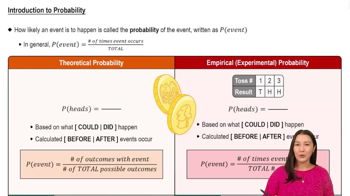
Probability

Probability is a measure of the likelihood that a particular event will occur, expressed as a number between 0 and 1. In the context of multiple-choice questions, it quantifies the chance of selecting a specific answer from a set of possible options. For example, if there are five choices (a, b, c, d, e), the probability of randomly guessing one correct answer is 1 out of 5, or 0.2.
추천 영상:
5:37
Introduction to Probability

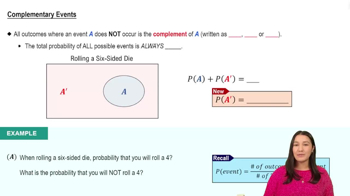
Complementary Events

Complementary events are pairs of outcomes in probability that cover all possible outcomes of an experiment. In this case, the event of guessing correctly (selecting the right answer) and guessing incorrectly (selecting any of the wrong answers) are complementary. If the probability of a correct answer is 0.2, then the probability of a wrong answer is the complement, calculated as 1 - 0.2, which equals 0.8.
추천 영상:
4:23
Complementary Events

Random Guessing

Random guessing refers to making a choice without any prior knowledge or strategy, leading to an equal likelihood of selecting any of the available options. In the scenario of a multiple-choice question with five answers, if a student guesses randomly, each answer has an equal probability of being chosen, which is crucial for calculating the overall probabilities of correct and incorrect answers.
추천 영상:
가이드 코스
07:09
Intro to Random Variables & Probability Distributions
관련 실천
교과서 질문

ESP A psychologist tells you that in an ESP (extrasensory perception) experiment, there is a 20% chance of answering a question correctly. What is the probability of answering a question correctly?

173
views

교과서 질문

Births in the United States In the United States, the true probability of a baby being a boy is 0.512 (based on the data available at this writing). For a family having three children, find the following.


d. The probability that at least one of the children is a girl.

237
views
교과서 질문

Subjective Probability Estimate the probability that the next time you watch a TV news report, it includes a story about a plane crash.

164
views
교과서 질문

In Exercises 6–10, use the following results from tests of an experiment to test the effectiveness of an experimental vaccine for children (based on data from USA Today). Express all probabilities in decimal form.


If 1 of the 1602 subjects is randomly selected, find the probability of getting 1 that developed flu.


126
views
교과서 질문

In Exercises 6–10, use the following results from tests of an experiment to test the effectiveness of an experimental vaccine for children (based on data from USA Today). Express all probabilities in decimal form.


If 1 of the 1602 subjects is randomly selected, find the probability of getting 1 who had the vaccine treatment and developed flu.

129
views
교과서 질문

National Statistics Day


b. If a person is randomly selected, find the probability that his or her birthday is in October. Ignore leap years.


132
views