Ch. 5 - Discrete Probability Distributions
Triola - Elementary Statistics 14th Edition
Triola14th EditionElementary StatisticsISBN: 9780137366446당신이 사용하는 게 아니라요?교과서 변경
5장, 문제 5.CRE.2a

Kentucky Pick 4 In the Kentucky Pick 4 lottery game, you can pay \$1 for a “straight” bet in which you select four digits with repetition allowed. If you buy only one ticket and win, your prize is \$2500.


a. If you buy one ticket, what is the probability of winning?

검증된 단계별 안내
1
Understand the problem: In the Kentucky Pick 4 lottery, you select four digits (0-9) with repetition allowed. The total number of possible outcomes is the total number of 4-digit combinations where each digit can range from 0 to 9.
Calculate the total number of possible outcomes: Since each digit has 10 possible values (0 through 9), and there are 4 digits, the total number of outcomes is given by \( 10^4 \).
Determine the number of favorable outcomes: To win, the exact 4-digit combination you selected must match the winning combination. Therefore, there is only 1 favorable outcome.
Calculate the probability of winning: Probability is defined as the ratio of favorable outcomes to total outcomes. Use the formula \( P(\text{winning}) = \frac{\text{favorable outcomes}}{\text{total outcomes}} \). Substitute the values from the previous steps.
Simplify the probability expression: Simplify the fraction \( \frac{1}{10^4} \) to express the probability in its simplest form.

비슷한 문제에 대한 검증된 영상 답변:

이 영상 해법은 위 문제에 도움이 된다고 튜터들이 추천한 것입니다.
영상 길이:
1m
도움이 되었나요?

주요 개념

질문에 올바르게 답하기 위해 반드시 이해해야 하는 핵심 개념들은 다음과 같습니다.

Probability

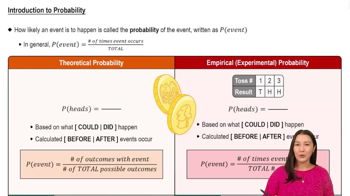
Probability is a measure of the likelihood that a particular event will occur, expressed as a number between 0 and 1. In the context of the Kentucky Pick 4 lottery, the probability of winning with a single ticket can be calculated by determining the total number of possible outcomes and the number of favorable outcomes (winning combinations).
추천 영상:
가이드 코스
5:37
Introduction to Probability

Combinatorics

Combinatorics is a branch of mathematics dealing with combinations and permutations of objects. In the Kentucky Pick 4 game, since digits can be repeated, the total number of possible combinations can be calculated using the formula for permutations with repetition, which is essential for determining the total outcomes in the lottery.

Expected Value

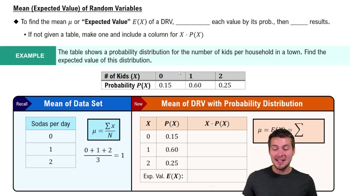
Expected value is a key concept in statistics that represents the average outcome of a random event when considering all possible outcomes and their probabilities. In the lottery context, understanding the expected value can help players assess whether the potential prize justifies the cost of the ticket, given the low probability of winning.
추천 영상:
가이드 코스
04:14
Expected Value (Mean) of Random Variables
관련 실천
교과서 질문

Find the mean of the random variable x described in the preceding exercise.

152
views

교과서 질문

Kentucky Pick 4 In the Kentucky Pick 4 lottery game, you can pay \$1 for a “straight” bet in which you select four digits with repetition allowed. If you buy only one ticket and win, your prize is \$2500.


c. If you play this game once every day, find the probability of no wins in 365 days.

92
views
교과서 질문

Tennis Challenge In a recent U.S. Open tennis tournament, there were 945 challenges made by singles players, and 255 of them resulted in referee calls that were overturned. The accompanying table lists the results by gender.


c. If two different challenges are randomly selected without replacement, find the probability that they both resulted in an overturned call.

93
views
교과서 질문

Is the mean found in the preceding exercise a statistic or a parameter?

132
views
교과서 질문

Tennis Challenge In a recent U.S. Open tennis tournament, there were 945 challenges made by singles players, and 255 of them resulted in referee calls that were overturned. The accompanying table lists the results by gender.


b. If one of the overturned calls is randomly selected, what is the probability that the challenge was made by a woman?

83
views
교과서 질문

In Exercises 6–10, refer to the accompanying table, which describes the numbers of adults in groups of five who reported sleepwalking (based on data from “Prevalence and Comorbidity of Nocturnal Wandering In the U.S. Adult General Population,” by Ohayon et al., Neurology, Vol. 78, No. 20).

Significant Events Is 4 a significantly high number of sleepwalkers in a group of 5 adults? Explain.

110
views