Ch. 5 - Discrete Probability Distributions
Triola - Elementary Statistics 14th Edition
Triola14th EditionElementary StatisticsISBN: 9780137366446당신이 사용하는 게 아니라요?교과서 변경
5장, 문제 5.1.17

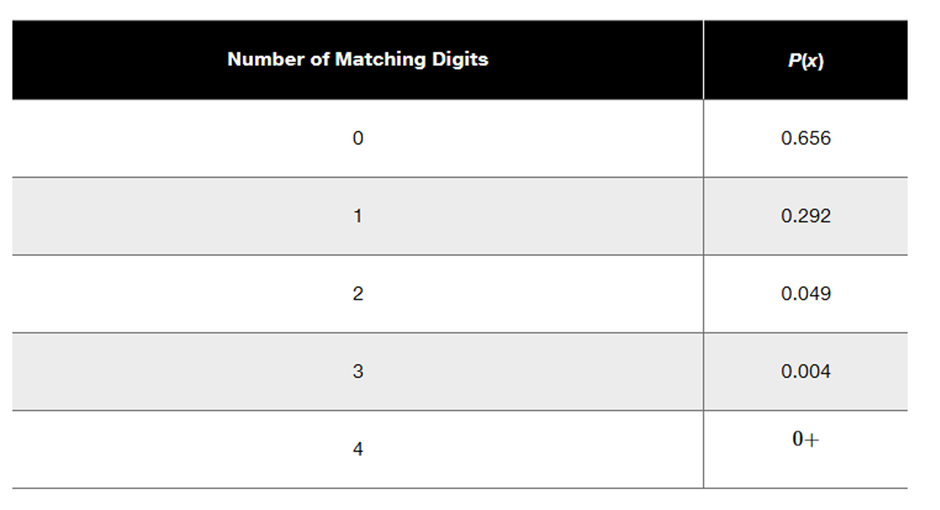
Lottery. In Exercises 15–20, refer to the accompanying table, which describes probabilities for the California Daily 4 lottery. The player selects four digits with repetition allowed, and the random variable x is the number of digits that match those in the same order that they are drawn (for a “straight” bet).


Table showing probabilities for matching digits in a lottery: 0 (0.656), 1 (0.292), 2 (0.049), 3 (0.004), 4 (0+).


Range Rule of Thumb for Significant Events Use the range rule of thumb to determine whether 4 matches is a significantly high number of matches.

검증된 단계별 안내
1
Step 1: Understand the problem. The goal is to determine whether 4 matches is a significantly high number of matches using the range rule of thumb. The range rule of thumb states that values are considered significantly high if they are greater than the mean plus two standard deviations.
Step 2: Calculate the mean (μ) of the random variable x. Use the formula for the mean of a probability distribution: μ = Σ[x * P(x)], where x represents the number of matching digits and P(x) represents the corresponding probability.
Step 3: Calculate the standard deviation (σ) of the random variable x. Use the formula for the standard deviation of a probability distribution: σ = √Σ[(x - μ)^2 * P(x)], where μ is the mean calculated in Step 2.
Step 4: Apply the range rule of thumb. Compute the threshold for significantly high values using the formula: μ + 2σ. Compare the value of 4 matches to this threshold.
Step 5: Interpret the result. If 4 matches exceed the threshold calculated in Step 4, it is considered a significantly high number of matches. Otherwise, it is not considered significant.

비슷한 문제에 대한 검증된 영상 답변:

이 영상 해법은 위 문제에 도움이 된다고 튜터들이 추천한 것입니다.
영상 길이:
3m
도움이 되었나요?

주요 개념

질문에 올바르게 답하기 위해 반드시 이해해야 하는 핵심 개념들은 다음과 같습니다.

Probability Distribution

A probability distribution describes how the probabilities of a random variable are distributed across its possible values. In this case, the table shows the probabilities of matching digits in the California Daily 4 lottery, where the random variable x represents the number of digits that match. Understanding this distribution is crucial for analyzing the likelihood of different outcomes in the lottery.
추천 영상:
가이드 코스
06:39
Calculating Probabilities in a Binomial Distribution

Random Variable

A random variable is a numerical outcome of a random phenomenon. In the context of the lottery question, the random variable x represents the number of digits that match the drawn numbers in the same order. Recognizing how random variables function helps in calculating probabilities and understanding the nature of the outcomes in probabilistic scenarios.
추천 영상:
가이드 코스
07:09
Intro to Random Variables & Probability Distributions

Range Rule of Thumb

The Range Rule of Thumb is a statistical guideline used to determine whether a particular outcome is significantly high or low compared to the expected range of values. It suggests that if an outcome is more than two standard deviations away from the mean, it can be considered significant. In this lottery context, applying this rule will help assess whether matching all four digits is an unusually high event.
추천 영상:
5:14
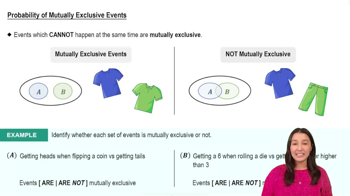
Probability of Mutually Exclusive Events
관련 실천
교과서 질문

If we sample from a small finite population without replacement, the binomial distribution should not be used because the events are not independent. If sampling is done without replacement and the outcomes belong to one of two types, we can use the hypergeometric distribution. If a population has A objects of one type (such as lottery numbers you selected), while the remaining B objects are of the other type (such as lottery numbers you didn’t select), and if n objects are sampled without replacement (such as six drawn lottery numbers), then the probability of getting x objects of type A and objects of type B is

In New Jersey’s Pick 6 lottery game, a bettor selects six numbers from 1 to 49 (without repetition), and a winning six-number combination is later randomly selected. Find the probability of getting exactly four winning numbers with one ticket.

101
views
교과서 질문

Identifying Probability Distributions. In Exercises 7–14, determine whether a probability distribution is given. If a probability distribution is given, find its mean and standard deviation. If a probability distribution is not given, identify the requirements that are not satisfied.

Online Courses College students are randomly selected and arranged in groups of three. The random variable x is the number in the group who say that they take one or more online courses (based on data from Sallie Mae).

253
views
교과서 질문

Independent Events Again assume that when randomly selecting a speaking character in a movie, the probability of getting a female is 0.331, as in Exercise 1. If we want to find the probability of 20 females when 50 different speaking characters are randomly selected from a population of 1500 speaking characters, are the 50 selections independent? Using the 5% guideline for cumbersome calculations, can they be treated as being independent?

143
views
교과서 질문

Random Variable The accompanying table lists probabilities for the corresponding numbers of unlicensed software packages when four software packages are randomly selected in China. What is the random variable, what are its possible values, and are its values numerical?


" style="" width="330">

146
views
교과서 질문

Discrete or Continuous? Is the random variable given in the table from Exercise 1 discrete or continuous? Explain.

215
views
교과서 질문

40% of consumers believe that cash will be obsolete in the next 20 years (based on a survey by J.P. Morgan Chase). In each of Exercises 15–20, assume that 8 consumers are randomly selected. Find the indicated probability.


Find the probability that no more than 3 of the selected consumers believe that cash will be obsolete in the next 20 years.

141
views