Ch. 5 - Discrete Probability Distributions
Triola - Elementary Statistics 14th Edition
Triola14th EditionElementary StatisticsISBN: 9780137366446당신이 사용하는 게 아니라요?교과서 변경
5장, 문제 5.2.40c

One of Mendel’s famous experiments with peas resulted in 580 offspring, and 152 of them were yellow peas. Mendel claimed that under the same conditions, 25% of offspring peas would be yellow. Assume that Mendel’s claim of 25% is true, and assume that a sample consists of 580 offspring peas.


c. Find the probability of 152 or more yellow peas.

검증된 단계별 안내
1
Step 1: Identify the problem as a binomial probability problem. The number of yellow peas (successes) follows a binomial distribution because there are a fixed number of trials (580 peas), two possible outcomes (yellow or not yellow), and a constant probability of success (25% or 0.25).
Step 2: Define the parameters of the binomial distribution. The number of trials (n) is 580, and the probability of success (p) is 0.25. The random variable X represents the number of yellow peas, and we are interested in finding P(X ≥ 152).
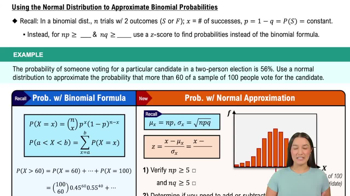
Step 3: Use the normal approximation to the binomial distribution. Since n is large and p is not too close to 0 or 1, the binomial distribution can be approximated by a normal distribution with mean μ = n * p and standard deviation σ = √(n * p * (1 - p)). Calculate μ and σ using the formulas: μ = 580 * 0.25 and σ = √(580 * 0.25 * 0.75).
Step 4: Apply the continuity correction. To approximate P(X ≥ 152) using the normal distribution, adjust the value to include the continuity correction: P(X ≥ 152) ≈ P(Z ≥ (152 - μ + 0.5) / σ), where Z is the standard normal variable.
Step 5: Standardize the value and use the standard normal distribution table. Compute the z-score using the formula Z = (152 - μ + 0.5) / σ. Then, use the standard normal distribution table or a statistical software to find the probability corresponding to the calculated z-score.

비슷한 문제에 대한 검증된 영상 답변:

이 영상 해법은 위 문제에 도움이 된다고 튜터들이 추천한 것입니다.
영상 길이:
4m
도움이 되었나요?

주요 개념

질문에 올바르게 답하기 위해 반드시 이해해야 하는 핵심 개념들은 다음과 같습니다.

Binomial Distribution

The binomial distribution models the number of successes in a fixed number of independent Bernoulli trials, each with the same probability of success. In this context, the 'success' is the occurrence of yellow peas, with a probability of 0.25. The distribution is characterized by two parameters: the number of trials (n) and the probability of success (p).
추천 영상:
가이드 코스
03:28
Mean & Standard Deviation of Binomial Distribution

Normal Approximation

For large sample sizes, the binomial distribution can be approximated by a normal distribution due to the Central Limit Theorem. This approximation is valid when both np and n(1-p) are greater than 5. In this case, with 580 trials and a probability of 0.25, the normal approximation can simplify the calculation of probabilities for the number of yellow peas.
추천 영상:
가이드 코스
06:23
Using the Normal Distribution to Approximate Binomial Probabilities

Cumulative Probability

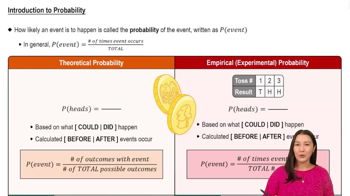
Cumulative probability refers to the probability that a random variable takes on a value less than or equal to a specific value. To find the probability of observing 152 or more yellow peas, one would calculate the cumulative probability for 151 yellow peas and subtract it from 1. This approach allows us to determine the likelihood of achieving a certain outcome in a binomial setting.
추천 영상:
가이드 코스
5:37
Introduction to Probability
관련 실천
교과서 질문

Using Probabilities for Significant Events


c. Which probability is relevant for determining whether 1 is a significantly low number of matches: the result from part (a) or part (b)?


126
views
교과서 질문

Tennis Challenge In a recent U.S. Open tennis tournament, there were 945 challenges made by singles players, and 255 of them resulted in referee calls that were overturned. The accompanying table lists the results by gender.


d. If 1 of the 945 challenges is randomly selected, find the probability that it was made by a man or was upheld with an overturned call.


95
views
교과서 질문

Politics The County Clerk in Essex, New Jersey, was accused of cheating by not using randomness in assigning the order in which candidates’ names appeared on voting ballots. Among 41 different ballots, Democrats were assigned the desirable first line 40 times. Assume that Democrats and Republicans are assigned the first line using a method of random selection so that they are equally likely to get that first line.


c. Find the probability of 40 or more first lines for Democrats.

109
views
교과서 질문

In Exercises 9–16, use the Poisson distribution to find the indicated probabilities.


Births In a recent year (365 days), NYU-Langone Medical Center had 5942 births.


c. Find the probability that in a single day, there are no births. Would 0 births in a single day be a significantly low number of births?

165
views
교과서 질문

Politics The County Clerk in Essex, New Jersey, was accused of cheating by not using randomness in assigning the order in which candidates’ names appeared on voting ballots. Among 41 different ballots, Democrats were assigned the desirable first line 40 times. Assume that Democrats and Republicans are assigned the first line using a method of random selection so that they are equally likely to get that first line.

.

d. Which probability is relevant for determining whether 40 first lines for Democrats is significantly high: the probability from part (b) or part (c)? Based on the relevant probability, is the result of 40 first lines for Democrats significantly high?


88
views
교과서 질문

In Exercises 31 and 32, assume that hybridization experiments are conducted with peas having the property that for offspring, there is a 0.75 probability that a pea has green pods (as in one of Mendel’s famous experiments).


Hybrids Assume that offspring peas are randomly selected in groups of 16.


c. Is a result of 7 peas with green pods a result that is significantly low? Why or why not?

147
views