
Ch. 7 - Estimating Parameters and Determining Sample Sizes
Triola - Elementary Statistics 14th Edition
Triola14th EditionElementary StatisticsISBN: 9780137366446당신이 사용하는 게 아니라요?교과서 변경
7장, 문제 7.1.35a

Airline Seating You are the operations manager for American Airlines and you are considering a higher fare level for passengers in aisle seats. You want to estimate the percentage of passengers who now prefer aisle seats. How many randomly selected air passengers must you survey? Assume that you want to be 95% confident that the sample percentage is within 2.5 percentage points of the true population percentage.


a. Assume that nothing is known about the percentage of passengers who prefer aisle seats.

검증된 단계별 안내
1
Step 1: Identify the formula for determining the required sample size for estimating a population proportion. The formula is: n = (Z^2 * p * (1 - p)) / E^2, where n is the required sample size, Z is the z-score corresponding to the desired confidence level, p is the estimated population proportion, and E is the margin of error.
Step 2: Determine the values for the variables in the formula. Since the confidence level is 95%, the corresponding z-score (Z) is approximately 1.96. The margin of error (E) is given as 2.5%, which is 0.025 in decimal form. Since nothing is known about the percentage of passengers who prefer aisle seats, assume the most conservative estimate for p, which is 0.5 (this maximizes the product p * (1 - p)).
Step 3: Substitute the values into the formula. Using p = 0.5, Z = 1.96, and E = 0.025, the formula becomes: n = (1.96^2 * 0.5 * (1 - 0.5)) / 0.025^2.
Step 4: Simplify the numerator of the formula. Calculate Z^2 (1.96^2), then multiply it by p (0.5) and (1 - p) (0.5). This gives the value for the numerator.
Step 5: Simplify the denominator of the formula. Square the margin of error (E = 0.025), then divide the numerator by this value to find the required sample size (n). Round up to the nearest whole number, as sample size must be an integer.

비슷한 문제에 대한 검증된 영상 답변:

이 영상 해법은 위 문제에 도움이 된다고 튜터들이 추천한 것입니다.
영상 길이:
2m
도움이 되었나요?

주요 개념

질문에 올바르게 답하기 위해 반드시 이해해야 하는 핵심 개념들은 다음과 같습니다.

Sample Size Determination

Sample size determination is a statistical method used to calculate the number of observations needed to achieve a desired level of confidence and precision in estimating a population parameter. In this scenario, the goal is to estimate the percentage of passengers who prefer aisle seats with a 95% confidence level and a margin of error of 2.5 percentage points.
추천 영상:
가이드 코스
06:14
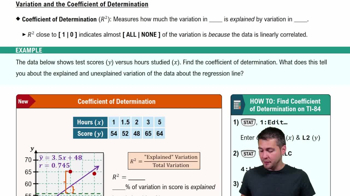
Coefficient of Determination

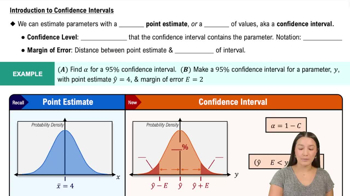
Confidence Level

The confidence level represents the degree of certainty that the true population parameter lies within the confidence interval derived from the sample. A 95% confidence level indicates that if the same sampling procedure were repeated multiple times, approximately 95% of the calculated intervals would contain the true population percentage of aisle seat preference.
추천 영상:
06:33
Introduction to Confidence Intervals

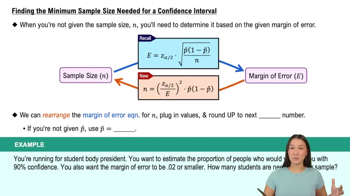
Margin of Error

The margin of error quantifies the range within which the true population parameter is expected to fall, based on the sample estimate. In this case, a margin of error of 2.5 percentage points means that the estimated percentage of aisle seat preference could vary by this amount above or below the sample percentage, affecting the reliability of the findings.
추천 영상:
04:08
Finding the Minimum Sample Size Needed for a Confidence Interval
관련 실천
교과서 질문

Controversial Song The song “Baby It’s Cold Outside” generated much controversy because of its lyrics and tone. CBS New York conducted a survey by asking viewers to use the Internet to respond to a question asking whether that song was really too offensive to play. Among 1043 Internet users who chose to respond, 986 said that the song was not too offensive, and 57 of the respondents said that the song was too offensive.


a. Construct a 95% confidence interval estimate of the proportion of the population having the belief that the song is not too offensive.


75
views
교과서 질문

Critical Thinking. In Exercises 17–28, use the data and confidence level to construct a confidence interval estimate of p, then address the given question.


Job Interviews In a Harris poll of 514 human resource professionals, 45.9% said that body piercings and tattoos were big personal grooming red flags.


a. Among the 514 human resource professionals who were surveyed, how many of them said that body piercings and tattoos were big personal grooming red flags?

128
views
교과서 질문

Voting Survey In a survey of 1002 people, 70% said that they voted in a recent presidential election (based on data from ICR Research Group). Voting records show that 61% of eligible voters actually did vote.


a. Among the 1002 people surveyed, what is the actual number of people who said that they voted?


150
views
교과서 질문

Brain Volumes Use these measures of brain volumes from Data Set 12 “IQ and Brain Size” in Appendix B. Use the bootstrap method with 1000 bootstrap samples.


a. Use 1000 bootstrap samples to construct a 90% confidence interval estimate of the population mean.

94
views
교과서 질문

Astrology A sociologist plans to conduct a survey to estimate the percentage of adults who believe in astrology. How many people must be surveyed if we want a confidence level of 99% and a margin of error of four percentage points?


a. Assume that nothing is known about the percentage to be estimated.


89
views
교과서 질문

Mean Pulse Rate of Males Data Set 1 “Body Data” in Appendix B includes pulse rates of 153 randomly selected adult males, and those pulse rates vary from a low of 40 bpm to a high of 104 bpm. Find the minimum sample size required to estimate the mean pulse rate of adult males. Assume that we want 99% confidence that the sample mean is within 2 bpm of the population mean.


a. Find the sample size using the range rule of thumb to estimate .


115
views