
Ch. 8 - Hypothesis Testing
Triola - Elementary Statistics 14th Edition
Triola14th EditionElementary StatisticsISBN: 9780137366446당신이 사용하는 게 아니라요?교과서 변경
8장, 문제 8.1.29

Interpreting Power Chantix (varenicline) tablets are used as an aid to help people stop smoking. In a clinical trial, 129 subjects were treated with Chantix twice a day for 12 weeks, and 16 subjects experienced abdominal pain (based on data from Pfizer, Inc.). If someone claims that more than 8% of Chantix users experience abdominal pain, that claim is supported with a hypothesis test conducted with a 0.05 significance level. Using 0.18 as an alternative value of p, the power of the test is 0.96. Interpret this value of the power of the test.

검증된 단계별 안내
1
Step 1: Understand the concept of 'power of a test'. The power of a statistical test is the probability that the test correctly rejects the null hypothesis (H₀) when the alternative hypothesis (H₁) is true. It is calculated as 1 - β, where β is the probability of a Type II error (failing to reject H₀ when H₁ is true).
Step 2: Identify the context of the problem. In this case, the null hypothesis (H₀) is that the proportion of Chantix users experiencing abdominal pain is 8% (p = 0.08). The alternative hypothesis (H₁) is that the proportion is greater than 8% (p > 0.08).
Step 3: Recognize the significance of the power value provided. A power of 0.96 means that there is a 96% probability of correctly rejecting the null hypothesis (H₀) when the true proportion of Chantix users experiencing abdominal pain is 18% (p = 0.18).
Step 4: Interpret the practical implication. A high power (0.96) indicates that the test is very effective at detecting a true difference (i.e., when the true proportion is 18%, the test will almost always reject the null hypothesis that the proportion is 8%).
Step 5: Conclude the interpretation. The power of 0.96 suggests that the test is highly reliable in identifying that the proportion of Chantix users experiencing abdominal pain is greater than 8% if the true proportion is indeed 18%.

비슷한 문제에 대한 검증된 영상 답변:

이 영상 해법은 위 문제에 도움이 된다고 튜터들이 추천한 것입니다.
영상 길이:
3m
도움이 되었나요?

주요 개념

질문에 올바르게 답하기 위해 반드시 이해해야 하는 핵심 개념들은 다음과 같습니다.

Hypothesis Testing

Hypothesis testing is a statistical method used to make decisions about a population based on sample data. It involves formulating a null hypothesis (H0) and an alternative hypothesis (H1), then using sample data to determine whether to reject H0. In this context, the null hypothesis would state that 8% or fewer Chantix users experience abdominal pain, while the alternative suggests that the proportion is greater than 8%.
추천 영상:
가이드 코스
06:21
Step 1: Write Hypotheses

Power of a Test

The power of a test is the probability that it correctly rejects the null hypothesis when the alternative hypothesis is true. It is calculated as 1 minus the probability of a Type II error (failing to reject H0 when H1 is true). A power of 0.96 indicates a very high likelihood of detecting a true effect (in this case, that more than 8% of users experience abdominal pain) if it exists.
추천 영상:
가이드 코스
06:34
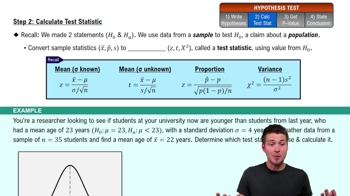
Step 2: Calculate Test Statistic

Significance Level

The significance level, denoted as alpha (α), is the threshold for determining whether to reject the null hypothesis. In this scenario, a significance level of 0.05 means there is a 5% risk of concluding that a difference exists when there is none (Type I error). It sets the standard for how strong the evidence must be to support the claim that more than 8% of users experience abdominal pain.
추천 영상:
가이드 코스
04:46
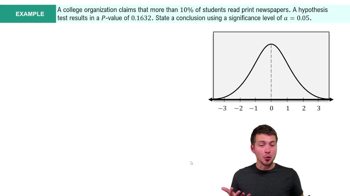
Step 4: State Conclusion Example 4
관련 실천
교과서 질문

Type I and Type II Errors

In Exercises 25–28, provide statements that identify the type I error and the type II error that correspond to the given claim. (Although conclusions are usually expressed in verbal form, the answers here can be expressed with statements that include symbolic expressions such as p = 0.1.)


The proportion of people who write with their left hand is equal to 0.1.

129
views
교과서 질문

Minting Dollar Coins For the sample data from Exercise 1, we get a P-value of 0.0041 when testing the claim that σ < 0.04000 g.


What should we conclude about the null hypothesis?

What should we conclude about the original claim?

What do these results suggest about the new minting process?

97
views
교과서 질문

Finding P-Values

In Exercises 13–16, do the following:


i. Identify the hypothesis test as being two-tailed, left-tailed, or right-tailed.

ii. Find the P-value. (See Figure 8-3.)

iii. Using a significance level of α = 0.05 should we reject H0 or should we fail to reject H0?


The test statistic of z = -0.75 is obtained when testing the claim that p<1/3.

165
views
교과서 질문

Testing Claims About Proportions

In Exercises 9–32, test the given claim. Identify the null hypothesis, alternative hypothesis, test statistic, P-value, or critical value(s), then state the conclusion about the null hypothesis, as well as the final conclusion that addresses the original claim. Use the P-value method unless your instructor specifies otherwise. Use the normal distribution as an approximation to the binomial distribution, as described in Part 1 of this section.


Belief in Ghosts In a Harris Interactive poll of 2250 adults, 42% of the respondents said that they believe in ghosts. Use a 0.01 significance level to test the claim that more than of adults believe in ghosts.

136
views
교과서 질문

Finding P-Values

In Exercises 13–16, do the following:


i. Identify the hypothesis test as being two-tailed, left-tailed, or right-tailed.

ii. Find the P-value. (See Figure 8-3.)

iii. Using a significance level of α = 0.05 should we reject H0 or should we fail to reject H0?


The test statistic of z = -1.60 is obtained when testing the claim that p ≠ 0.455.

226
views
교과서 질문

Randomization: Testing a Claim About a Mean

In Exercises 9–12, use the randomization procedure for the indicated exercise.

Section 8-3, Exercise 21 “Lead in Medicine”

112
views