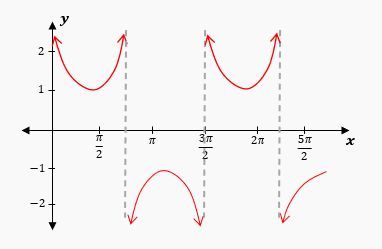
Below is a graph of the function y=csc(bx). Determine the value of b.
A
b=21
B
b=3
C
b=34
D
b=43π
0 댓글
검증된 단계별 안내
1
Understand the function y = csc(bx). The cosecant function, csc(x), is the reciprocal of the sine function, so y = csc(bx) = 1/sin(bx). The graph of csc(bx) will have vertical asymptotes where sin(bx) = 0.
Identify the period of the function from the graph. The period of csc(bx) is the distance between consecutive vertical asymptotes. From the graph, the vertical asymptotes occur at x = π/2, 3π/2, 5π/2, etc., indicating a period of π.
Recall that the period of the function y = csc(bx) is given by the formula Period = 2π/b. Since the period from the graph is π, set up the equation: π = 2π/b.
Solve the equation π = 2π/b for b. Divide both sides by π to isolate b, resulting in 1 = 2/b.
Multiply both sides by b and then divide by 2 to solve for b, yielding b = 2.


 검증된 단계별 안내

