Skip to main content
Trigonometry
나의 코스
배우기
시험 준비
AI 튜터
학습 가이드
교과서적 해결책
플래시카드
탐험해 보세요
앱을 사용해 보세요
나의 코스
배우기
시험 준비
AI 튜터
학습 가이드
교과서적 해결책
플래시카드
탐험해 보세요
앱을 사용해 보세요
뒤로
Convert Points Between Polar and Rectangular Coordinates definitions
카드를 뒤집기 위해 탭할 수 있습니다.
Polar Coordinates
카드를 뒤집기 위해 탭할 수 있습니다.
👆
Polar Coordinates
A system representing points by distance from the origin and angle from the positive x-axis, useful for circular and rotational contexts.
진행 상황 추적
컨트롤 버튼이 '내비게이션' 모드로 변경되었습니다.
1/15
관련 플래시카드
관련 실천
추천 영상
Convert Points Between Polar and Rectangular Coordinates quiz #1
Convert Points Between Polar and Rectangular Coordinates
10 용어
Convert Points Between Polar and Rectangular Coordinates
9. Polar Equations
3 문제점
주제
ErnestBlazevic
Convert Equations Between Polar and Rectangular Forms
9. Polar Equations
3 문제점
주제
ErnestBlazevic
9. Polar Equations
4 주제
10 문제점
장
Patrick
VideoThumbView.guidedCourse
2:21
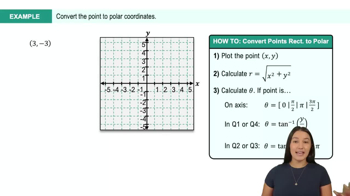
Convert Points from Rectangular to Polar Example 1
501
views
2
rank
VideoThumbView.guidedCourse
6:58
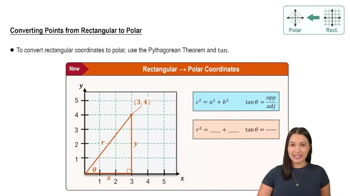
Convert Points from Rectangular to Polar
498
views
2
rank
VideoThumbView.guidedCourse
06:17
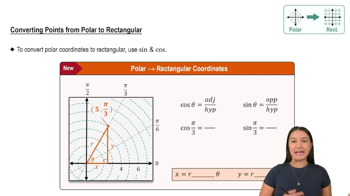
Convert Points from Polar to Rectangular
613
views
2
rank
이 집합의 용어 (15)
하이드의 정의
Polar Coordinates
A system representing points by distance from the origin and angle from the positive x-axis, useful for circular and rotational contexts.
Rectangular Coordinates
A system representing points by horizontal and vertical distances from the origin, commonly used in Cartesian graphs.
Hypotenuse
The longest side of a right triangle, connecting the origin to a point in polar coordinates and used to calculate r.
Unit Circle
A circle with radius 1 centered at the origin, foundational for understanding trigonometric relationships in coordinate conversions.
Cosine
A trigonometric function relating the adjacent side to the hypotenuse, used to find the x-component in conversions.
Sine
A trigonometric function relating the opposite side to the hypotenuse, used to find the y-component in conversions.
Inverse Tangent
A function used to determine the angle from the ratio of y to x, essential for finding θ in polar coordinates.
Quadrant
One of four regions in the coordinate plane, important for adjusting angles during conversions between systems.
Pythagorean Theorem
A formula relating the sides of a right triangle, used to calculate the distance r from x and y values.
Quadrantal Angle
An angle located on the axes, such as 0, π/2, π, or 3π/2, relevant when points lie directly on x or y axes.
Origin
The central point (0,0) in both coordinate systems, corresponding to r = 0 in polar coordinates.
Angle θ
The measure from the positive x-axis to the line connecting the origin to the point, crucial for polar representation.
Radius r
The distance from the origin to a point, forming the hypotenuse in the triangle used for conversions.
Decimal Form
A numerical representation used for easier plotting and visualization of coordinates on graphs.
Coordinate System
A framework for locating points, either by (x, y) or (r, θ), enabling conversion and comparison between representations.
 뒤로뒤로
뒤로뒤로

 2:21
2:21