Skip to main content
Trigonometry
나의 코스
배우기
시험 준비
AI 튜터
학습 가이드
교과서적 해결책
플래시카드
탐험해 보세요
앱을 사용해 보세요
나의 코스
배우기
시험 준비
AI 튜터
학습 가이드
교과서적 해결책
플래시카드
탐험해 보세요
앱을 사용해 보세요
뒤로
Phase Shifts quiz
카드를 뒤집기 위해 탭할 수 있습니다.
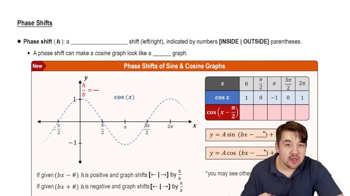
What is a phase shift in trigonometric functions?
카드를 뒤집기 위해 탭할 수 있습니다.
👆
What is a phase shift in trigonometric functions?
A phase shift is a horizontal shift of the graph of a sine or cosine function, moving it left or right.
진행 상황 추적
컨트롤 버튼이 '내비게이션' 모드로 변경되었습니다.
1/15
관련 플래시카드
관련 실천
추천 영상
Phase Shifts definitions
Phase Shifts
15 용어
Phase Shifts
4. Graphing Trigonometric Functions
3 문제점
주제
AllySteele
Graphs of Secant and Cosecant Functions
4. Graphing Trigonometric Functions
3 문제점
주제
AllySteele
4. Graphing Trigonometric Functions
4 주제
8 문제점
장
Patrick
VideoThumbView.guidedCourse
3:42
Example 1
916
views
21
rank
1
comments
VideoThumbView.guidedCourse
6:31
Phase Shifts
1564
views
10
rank
2
comments
이 집합의 용어 (15)
하이드의 정의
What is a phase shift in trigonometric functions?
A phase shift is a horizontal shift of the graph of a sine or cosine function, moving it left or right.
How do you identify a phase shift in a sine or cosine function?
A phase shift occurs when a constant is added or subtracted inside the function's argument, such as in sine(x - h) or cosine(x + h).
What is the formula to calculate the magnitude of a phase shift?
The magnitude of a phase shift is given by h/b, where h is the phase shift constant and b is the coefficient of x.
If you have cosine(x - pi/2), in which direction and by how much is the graph shifted?
The graph is shifted to the right by pi/2 units.
What happens to the graph when you subtract a positive number inside the function's argument?
Subtracting a positive number shifts the graph to the right by that amount divided by the coefficient of x.
How does adding a number inside the function's argument affect the graph?
Adding a number shifts the graph to the left by the value of the number divided by the coefficient of x.
What is the effect of the coefficient 'b' in the phase shift formula h/b?
The coefficient 'b' scales the phase shift, so the actual shift is h divided by b.
How can a phase shift make a cosine graph resemble a sine graph?
A phase shift can align the starting points and peaks of the cosine graph with those of the sine graph, making them look similar.
What is the period of the function y = sin(2x)?
The period is pi, calculated as 2pi divided by the coefficient 2.
For y = sin(2x + pi), what is the phase shift and in which direction?
The phase shift is pi/2 units to the left.
How do you graph a sine or cosine function with a phase shift?
Adjust the starting point and subsequent points by the phase shift, then connect these points smoothly to form the new wave.
If the inside of the function is bx - h, what is the direction of the phase shift?
The graph shifts to the right by h/b units.
If the inside of the function is bx + h, what is the direction of the phase shift?
The graph shifts to the left by h/b units.
Why might different textbooks use different letters for the phase shift constant?
Different textbooks may use different variables, but the concept remains the same as long as a constant is added or subtracted inside the function.
How can rewriting y = sin(2x + pi) as y = sin[2(x + pi/2)] help with graphing?
It makes it clear that the graph is shifted left by pi/2 units, helping to visualize the transformation.
 뒤로뒤로
뒤로뒤로

 3:42
3:42